Custom Dog Portrait From Photo - Six Steps
A practical six-step guide to commissioning a custom dog portrait from a phone photograph in 2026. Resolution specs, lighting tests, framing recommendations, and what kills a portrait before it starts.
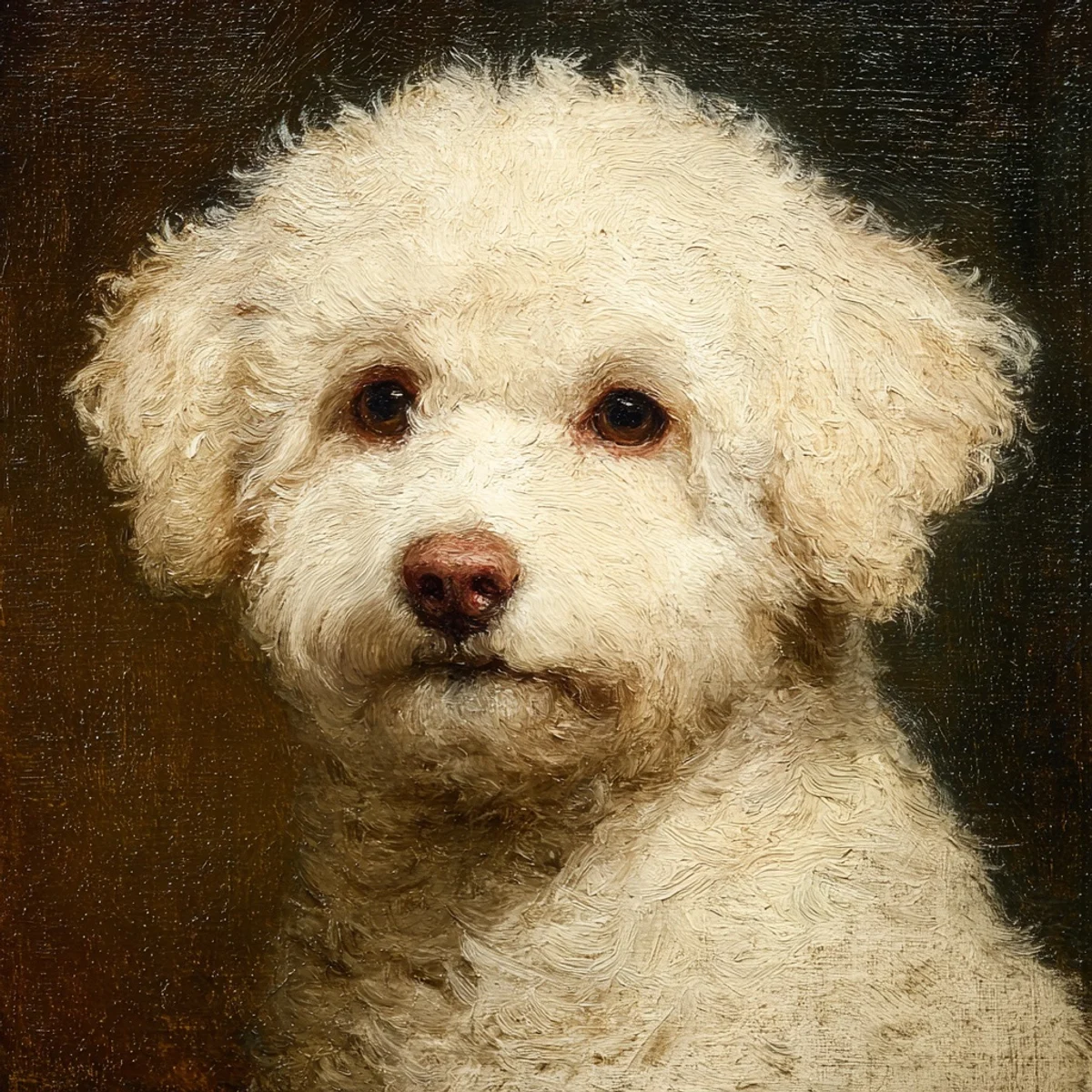
Most guides to commissioning a custom dog portrait skip over the part that actually determines whether the portrait works: the photograph you upload. Spend ten minutes getting the photograph right and the rest of the commission is a formality. Skip that step and no amount of style choice, frame quality, or atelier reputation will save the result.
This is the six-step version, written by people who turn photographs into portraits every day. Each step has a clear pass-or-fail check.
Step 1 - Take the photograph in window light
Not floor-level lamp light. Not under a kitchen pendant. Not in a dim corner where you happened to find the dog sleeping. The single biggest variable in portrait quality is the light falling on the dog's face when the photograph is taken.
The reliable answer: a north or east-facing window in mid-morning, between 9 and 11am. The dog standing or sitting about a metre back from the glass, body angled 30-45 degrees away from the window, head turned slightly toward you. The light wraps the muzzle, defines the eye sockets, and gives the coat dimension.
Pass: you can see distinct catchlight (a small bright reflection) in both eyes.
Fail: the face is flat, the eyes are dark voids, or there is a harsh shadow across the snout.
If your house does not have a good north window, the alternative is outdoor light in overcast weather. Direct sun is too harsh; overcast diffuses it perfectly. Avoid bright sunlight, especially around midday - it makes the coat go bleached and the eye-sockets go black.
Step 2 - Frame the photograph above the chest
This is the framing rule that almost everyone gets wrong. The dog should fill the frame from the top of the head down to about mid-chest. Not just the head (too close - loses the bearing). Not the whole body (too far - the face loses detail). Three-quarter body framing is what classical portraitists used and it is the framing the atelier rendering pipeline expects.
The classical pose is the dog facing you but slightly turned - one shoulder higher than the other, head turned 15-30 degrees toward the camera. This is the same compositional rule that Velazquez and Sargent used. It is not difficult to achieve - hold a treat just above and slightly to one side of the lens.
Pass: the top of the dog's head sits in the upper third of the frame, the chest fills the lower third, the face is centred horizontally.
Fail: the dog is full-body and tiny in the frame, or the photograph is so close that only the face fits.
Step 3 - Get the resolution right
Phone cameras in 2026 take photographs at 12 megapixels or higher. Any modern phone in the last five years is fine. What kills the portrait is one of these:
- A photograph that has been screenshot from social media (compressed twice, low res)
- A photograph that has been digitally zoomed to crop the dog closer (loses resolution)
- A photograph emailed to yourself in small format (some email clients downsize attachments)
- An old photograph from a 2014-era phone (5 megapixel or less)
Pass: the original full-resolution photograph, opened on your phone, is at least 2,000 pixels on the short side.
Fail: the photograph is under 1,000 pixels on the short side, or visibly pixelated when zoomed in to the dog's eyes.
The fix for low resolution is almost always to take a new photograph rather than try to enhance an existing one. AI upscaling is real but it cannot manufacture detail that was never captured.
Step 4 - Choose the style that suits the dog, not your home
This is the step where most buyers get it wrong by choosing the style that "fits the kitchen" or "matches the sofa." The dog should drive the style choice, not the interior.
A short matching exercise:
- Regal posture, observant, composed → Royal Portrait or Oil Painting
- Soft expression, gentle character, long coat → Soft Watercolour
- Playful, charming, lots of character → Storybook
- Sleek, modern, suits a minimalist home → Minimal Line
- A dog you have lost → Memorial
If you cannot decide, the €69 three-style tier is the right answer - you see the dog rendered in three styles and pick the one that actually looks like them. Most owners are surprised by which style works; what looks right in theory often does not survive contact with the actual dog's face.
Our breed-by-breed style guide goes into more detail.
Step 5 - Order the file, not the canvas
This is a 2026 decision that did not exist five years ago. You can either order:
- A digital file (€39-€99 at Olea and Hound) that you print and frame locally
- A printed canvas delivered to your door (€70-€200 from Crown and Paw, West and Willow, etc.) that arrives 7-21 days later
The digital file is the better value for almost every use case. Total framed cost: €55-€135 depending on print size and frame quality. You control the paper, the size, the frame style. The file is yours forever and you can reprint at any size later.
The shipped canvas saves you the print shop visit at the cost of 7-21 days of waiting and one frame style. Use it only if you genuinely do not want to deal with the print step.
The exception: gift portraits where the surprise needs to be physical. A wrapped canvas under the tree is more dramatic than a card that says "your portrait is in the inbox." For all other use cases the digital file wins.
Step 6 - Print at A2 on archival paper, in a real frame
The final step that separates a portrait that looks like art from one that looks like a printout. A4 home printing is fine for a phone wallpaper or a small bedside frame; for the wall, print at A2.
The specification we recommend:
- Print size: A2 (594 × 420 mm)
- Paper: Hahnemühle Photo Rag 308gsm, German Etching, or any archival fine-art paper at your local print shop
- Cost: €25-€35 for the print
- Frame: dark walnut or natural oak, 25-40mm wide
- Mount: cream or off-white double mount, 60mm border
- Frame cost: €40-€60 at a competent framer
- Total: €100-€135 for an A2 framed portrait on the wall
Skip the supermarket frame. The €5 frame is the single biggest reason that good portraits end up looking cheap. Spend €40 on a real wooden frame from a local framer or a decent online shop (Frame It Easy, Print Tiger, IKEA's Knoppäng line for budget options).
Hang at eye-line or slightly above. Not below eye-line - portraits read awkwardly when looked down on. Not too high - the dog's eyes should meet yours when you stand in front of the piece.
Frequently asked questions
How long does the rendering actually take?
Approximately 30 seconds from photo upload to seeing all six styles previewed. If a tool claims "instant" it is usually pre-rendering placeholder images; the real likeness-rendering takes 20-40 seconds end-to-end.
What if my dog has unusual markings?
Distinctive markings (a single white sock, a brindle pattern, a heterochromia eye) usually render well. Symmetrical markings render best; chaotic patches (large saddle markings, complex tabby) sometimes simplify in rendering. Order the three-style tier to compare across styles before committing if you are unsure.
Can I include multiple dogs in one portrait?
Yes. Upload one photo with both dogs in frame, or upload separate photos and ask the atelier to compose them together. We do this at no extra cost. Most competitors charge €20-€40 per additional pet because they price by canvas surface area.
What if the rendering does not look like my dog?
Refund within five minutes from rendering, no questions asked. After five minutes the file is yours to keep. This is unusual in the category - most physical-canvas competitors offer no refund because the canvas is already in production.
Is the file good enough for a really large print?
A2 (420 × 594 mm) is comfortable. A1 (594 × 841 mm) is the practical upper limit at 4,096 × 4,096 pixels. Above A1 the print will start to show pixel structure if viewed close up.
Do you ship the printed canvas?
No. We deliver a digital file only. This is a deliberate choice - it keeps total cost down (€55-€135 framed vs €140-€180 for a shipped canvas) and gives you full control over print size, paper, and frame. We do not have a print or shipping operation.
Begin with their photograph
Upload one photograph of your dog and see all six styles in 30 seconds. Free preview, refund within five minutes if it isn't them.
Six steps. Most owners finish all six in under an hour, including the framing visit. The portrait then sits on the wall for the rest of the dog's life and well beyond.