How to Print and Frame a Digital Pet Portrait
The practical guide to taking a digital pet portrait file from inbox to framed-on-the-wall. Print shops, paper choices, frame styles, and what to specifically ask for so the result reads as fine art and not as a printout.
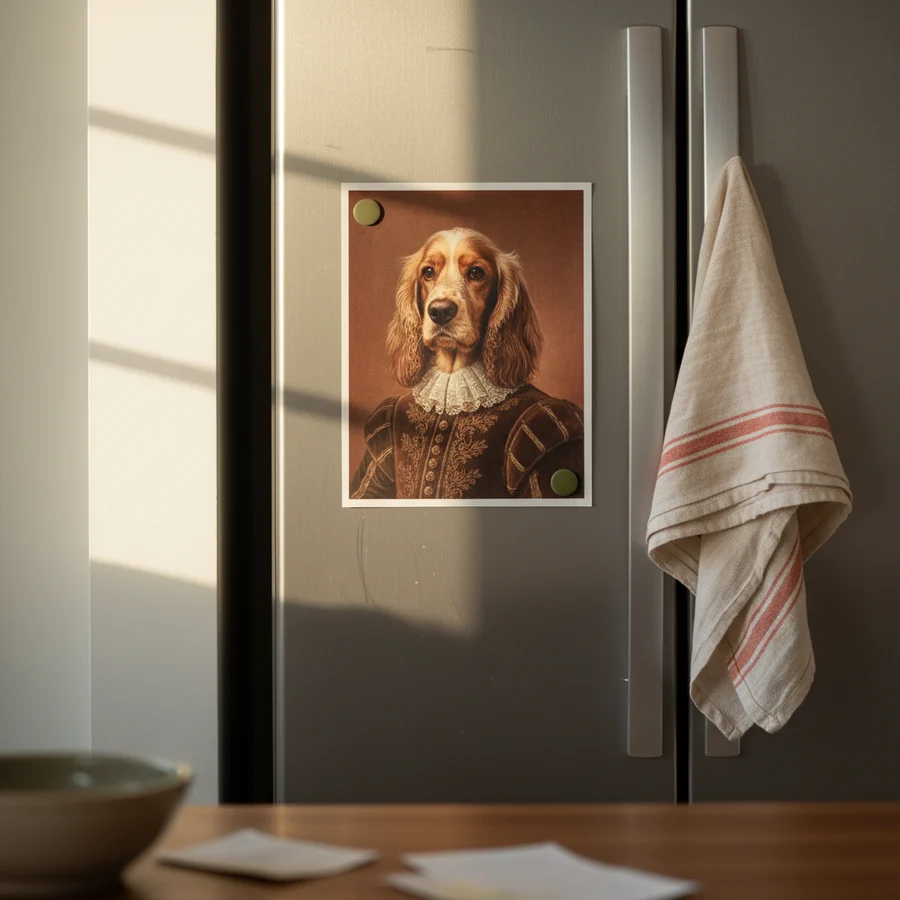
You have downloaded the digital file. Now what.
The print and framing step is where most digital pet portraits either land beautifully or end up looking cheap. Spend €20 on the wrong paper at a high-street printer and the portrait reads as a printout. Spend €60 at a fine-art print shop and the same file reads as a real piece of art on a wall.
This is the practical guide, with specific paper recommendations, frame recommendations, and a checklist of what to ask the framer.
The six-step procedure
A summary you can read in 30 seconds, before we go into detail.
- Choose the print size (A2 for most uses)
- Choose the paper (Hahnemühle Photo Rag 308gsm is the gold standard)
- Take the file to a fine-art print shop (not a high-street photo printer)
- Choose the frame (dark walnut or natural oak, 25-40mm wide)
- Choose the mount (cream double mount, 60mm border)
- Hang at eye-line on a wall with adjacent personal pieces
Total cost: €60-€135 depending on size and quality choices. Plan two weeks from file download to portrait on the wall.
Step 1 - Choose the print size
The most common size we recommend is A2 (594 × 420 mm). This is the size that anchors a wall and reads as substantial without dominating a room. Our digital files at 4,096 × 4,096 pixels print cleanly to A2 at 300 dpi - genuinely sharp, no pixelation visible at normal viewing distance.
A2 is the right answer for:
- A feature wall in a living room
- Above a console table in a hallway
- Above a mantel (if the mantel is wide enough)
- A staircase landing
A3 (420 × 297 mm) is the next size down. Use A3 for:
- A side wall in a smaller room
- A home office wall
- A second portrait paired with an A2 main portrait
A4 (297 × 210 mm) and smaller is for:
- A bedside table
- A bookshelf placement
- A small kitchen or breakfast room
A1 (841 × 594 mm) is the maximum we recommend. The file supports A1 at 200 dpi which is acceptable but starts to show pixel structure if viewed close up. Skip A0.
Step 2 - Choose the paper
The paper choice matters as much as the print size. A2 on the wrong paper looks worse than A4 on the right paper.
The gold standard: Hahnemühle Photo Rag 308gsm
A 100% cotton fine-art paper with a slight texture. Matte finish (no glare under indoor lighting). The paper that fine-art photographers and gallery printers use as standard. Archival rating is over 100 years.
A2 print on Hahnemühle Photo Rag at a competent fine-art print shop: €25-€35.
Good alternatives
- Hahnemühle German Etching: similar quality, slightly heavier texture, suits Oil Painting and Royal Portrait styles particularly well
- Hahnemühle Bamboo: matte, slight warm tone, suits Watercolour and Memorial styles
- Canson Infinity Rag Photographique: equivalent to Hahnemühle Photo Rag, slightly different texture
- Epson Hot Press Bright: smooth matte finish, suits Minimal Line and modern pieces particularly well
What to avoid
- Glossy photo paper. The reflective finish reads as a photograph print rather than a fine-art piece. Glare from room lighting makes it unwatchable.
- Lustre or semi-gloss paper. Same problem as glossy, slightly less severe.
- Standard inkjet paper. Not archival; will fade in 5-10 years.
- Canvas wraps. Different aesthetic entirely - canvas wraps suit some portraits but read as commercial rather than fine art. Acceptable for Oil Painting if you specifically want the canvas-wrap effect.
A home-printing option for A4 or smaller
For a small bedside or shelf piece, a decent home inkjet printer with archival ink and matte fine-art paper produces acceptable results at A4 and smaller. Look for an Epson EcoTank or a Canon Pixma Pro printer; use Hahnemühle Photo Rag or Canson cut sheets; expect to spend €15-€25 per print between paper and ink.
This does not scale to A3 or A2 without serious printer investment. For larger prints, use a fine-art print shop.
Step 3 - Find a fine-art print shop
This is the step where most owners give up and use a high-street photo printer because they do not know where else to go. The wrong choice. High-street photo printers (Boots, Snappy Snaps, supermarket photo counters) print on glossy photo paper at low resolution and produce results that look exactly like what they are.
What to look for in a print shop
- Stocks Hahnemühle, Canson, or Epson fine-art papers (ask specifically)
- Calibrates monitors to ICC profile (technical detail, but it indicates competence)
- Has displayed portfolio samples of previous fine-art prints
- Offers giclée printing (a specific term for archival pigment-ink printing)
- Will let you do a proof print before committing to the full size
Where to find one
- In the UK: theprintspace, Loxley Colour, Whitewall, Genesis Imaging
- In the EU: Whitewall (Germany), Saal Digital (Germany), Pictorem (France)
- Online with EU shipping: Whitewall is the most reliable
- In Malta: smaller market, but ask at any framing shop in Valletta or Sliema - several have arrangements with EU fine-art printers
- In the US: Mpix, ProDPI, Bay Photo Lab
Online fine-art print services are usually cheaper than local print shops and the quality is consistent. Shipping adds €10-€20 but the final result is often better than what local mid-tier print shops produce.
Step 4 - Choose the frame
The frame matters more than most owners realise. A €5 supermarket frame can take a €100 print and make it look like a €20 print. A €60 real wooden frame can take a €30 print and make it look like a €200 piece of art.
The default recommendation
- Wood: dark walnut, natural oak, or black-stained ash
- Width: 25-40mm
- Profile: flat or shallow box (not heavily ornate)
- Finish: matte, not gloss
This default works for Royal, Oil Painting, Watercolour, Storybook, and Memorial styles. The Minimal Line style suits a thinner frame (15-25mm wide) in natural oak or ash.
Where to get a real frame
- Local framing shops are usually the best option for one-off pieces. €40-€80 for an A2 frame in proper wood. Take the print with you so the framer can match.
- IKEA Knoppäng line is the budget option that does not look budget. €15-€25 for an A2 frame in dark wood. Acceptable for casual placements; just slightly less substantial than a proper bespoke frame.
- Frame It Easy, Print Tiger, Custom Frame Solutions are online options that ship pre-cut frames at moderate quality. €30-€60 for A2.
Avoid: supermarket frames, Amazon basic frames, and most clip-frame styles. These materially detract from the print quality.
Step 5 - Choose the mount
The mount (the cardstock border between the print and the frame) is often skipped, and skipping it is a mistake.
The default mount specification
- Colour: cream or off-white (not pure white)
- Type: double mount (two layers, with the inner layer showing a thin strip of contrasting colour)
- Width: 60-80mm border
- Material: acid-free / archival mount board
A double mount with a 60-80mm border around an A2 print produces a final outside dimension of approximately 730-770mm × 560-580mm. This is the size to specify when ordering a frame.
When to skip the mount
The Minimal Line style sometimes works without a mount - the line drawing reads cleanly all the way to the frame edge. Even then, a small (20-30mm) mount is usually better than no mount.
Step 6 - Hang it properly
The final step that determines whether the framed portrait works in the room.
Height
Hang at eye-line. The centre of the portrait should be at approximately 155cm from the floor for a standard-height home. Above the mantel can be higher (170cm from floor to centre is standard for above-mantel placement).
Spacing from other pieces
Memorial portraits and gentle portraits (Watercolour, Storybook) want breathing room - 30-50cm from the nearest other framed piece. Royal Portraits and Oil Paintings can sit slightly closer to other formal pieces.
Lighting
Indirect daylight is ideal. Direct sunlight fades the print over years - move the portrait if it spends part of each day in direct sun. Indoor LED downlights are fine for evening viewing.
Hardware
D-rings and picture wire on the back of the frame, hung from two hooks on the wall (not one). The two-hook hang keeps the portrait level over years and distributes weight properly.
Frequently asked questions
Can I just send the file to a regular high-street printer?
You can, and the result will look like a high-street print. For an Olea and Hound portrait that you have paid €39 for the file, the marginal cost of going to a proper print shop is €10-€20 and the quality difference is substantial. We strongly recommend the fine-art print shop.
Is glossy paper ever acceptable?
For a Minimal Line print, gloss can read as modern and clean. For every other style, matte fine-art paper is the right answer.
Do you handle the printing for me?
No. We are a digital-file atelier specifically. We do not have a print or shipping operation - this is a deliberate choice that keeps our pricing low and gives you full control over print size, paper, and frame. The print step is yours.
What if I want it printed on canvas instead of paper?
Canvas reads as a different aesthetic - more commercial, less fine-art. Acceptable for the Oil Painting style if you specifically want the canvas-wrap look. Most online canvas-wrap services (CanvasChamp, Canvas On Demand) can take a 4,096 × 4,096 PNG and produce a 16x20 or 20x24 canvas wrap for €35-€80. The quality is decent for the price but not the same as a giclée print on fine-art paper.
How long should the framing process take?
Two weeks is realistic. One week to print (longer if shipping from Whitewall or another online service). One week to frame at a local framer. Faster is possible (same-day at some local print-and-frame shops) but the quality is usually lower.
Do you have a recommended framer in Malta?
We are aware of several competent framers in Sliema and Valletta. Specific recommendations change too often to publish; ask the local framing shop whether they have experience with archival fine-art paper. If the answer is yes and the shop has displayed examples, they are competent.
What if my print arrives damaged?
Most fine-art print shops will reprint at no charge if the print arrives damaged. Always check the print on receipt and contact the shop within 48 hours if anything is wrong.
Begin with their photograph
If you have not yet commissioned the portrait, upload one photograph and see all six styles in 30 seconds. Then the print-and-frame process above takes you from file to wall in roughly two weeks.
The digital-file approach keeps the total cost lower than shipped-canvas alternatives (€55-€135 framed vs €140-€180 for an equivalent canvas from a competitor). The trade is that the framing step is yours. With the spec above, the result is materially better than what most physical-canvas competitors deliver - because you control every variable.