Pet Portraits at Home - A Room by Room Guide
How to place a pet portrait in each room of the house. Which styles suit which spaces, which rooms reject portraits entirely, and the placement specifics that turn a print into a room anchor.
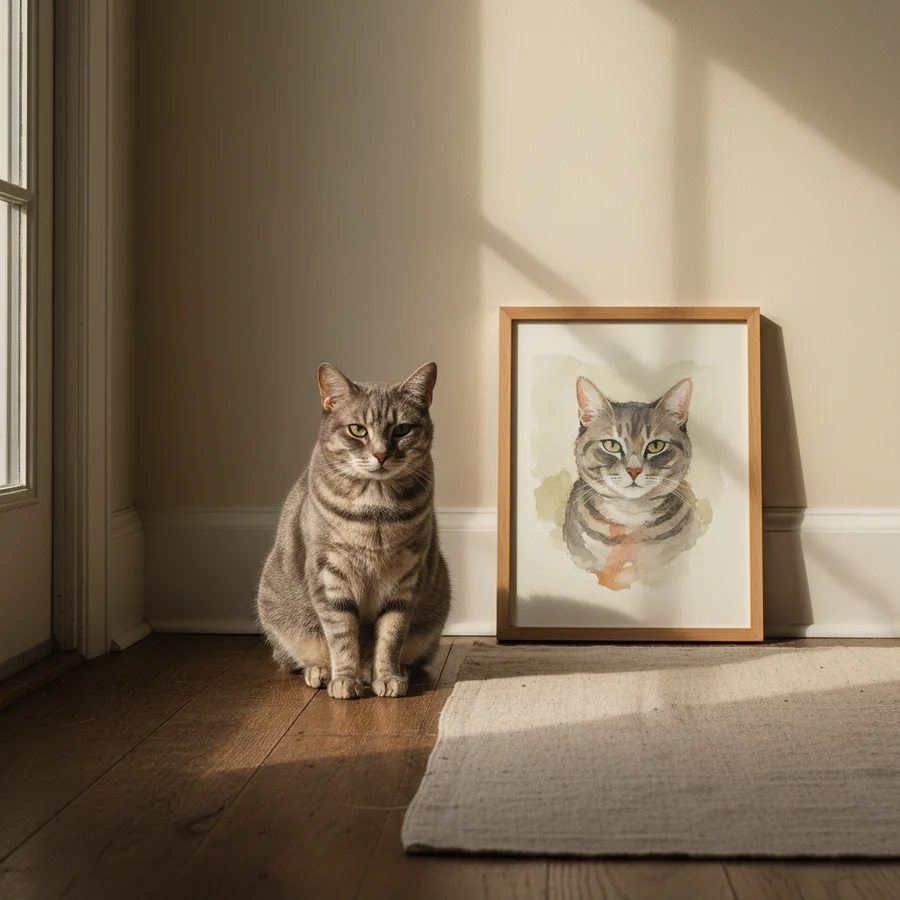
Pet portraits are different from other framed pieces in a home. A landscape print is decorative; a portrait of a specific animal in the household is participatory. The dog or cat is in the room with the portrait, and the placement has to acknowledge both presences. Get it right and the portrait becomes a room anchor. Get it wrong and it reads as a slightly odd memorial to a still-living pet, or as a misplaced piece of furniture art.
This is the room-by-room guide. We will be honest about which rooms reject pet portraits entirely.
The framework
Two principles before the rooms:
1. The portrait should match the rest of the wall's mood. A formal Royal Portrait in a casual playroom fights the room. A Minimal Line piece in a heavily layered living room disappears. Choose the style that fits the room before you commission the portrait.
2. The dog or cat does not need to see the portrait. This is the part most owners overthink. The portrait is for humans, not for pets. Pets do not recognise their own image in a framed piece and do not respond to it. Place the portrait for human use; the dog or cat will lie under it indifferently as you ask whether they recognise themselves.
The living room
The default room for the main household portrait. Most owners commission their first Olea and Hound piece for this room.
What works
- A side wall, at eye-line. Not above the mantel (too formal for most homes). Not over the sofa (the standard placement, but the sofa back interferes with viewing). A side wall where the portrait can hang with breathing room and be seen from a seated position elsewhere in the room.
- Royal Portrait or Oil Painting style in formal rooms. Storybook or Soft Watercolour in casual rooms. The room sets the register.
- A2 size as the default. Smaller reads as bedside; larger dominates.
- Dark walnut or natural oak frame with a cream double mount.
What does not work
- Directly above the sofa where seated viewers cannot see it
- Centred over the mantel unless the mantel is wide and the room is formal
- Pure white walls with no other framed pieces nearby (the portrait reads as isolated)
- More than two pet portraits in one living room (becomes a gallery)
The hallway
Often the second-best room for a pet portrait, sometimes the best.
What works
- A long hallway with sequenced framed pieces. Pet portrait as one piece in a sequence of family photographs, small prints, mirrors. The portrait fits in.
- Above a console table if the hallway has one. A2 portrait above the console reads as a focal piece without being a feature wall.
- At the top of a staircase landing. Excellent placement that gets multiple daily acknowledgements without becoming central.
What does not work
- A narrow front hallway where the portrait is the first thing every visitor sees
- A dim hallway with no natural light (portraits need indirect daylight)
- Isolated on a hallway wall with no other framed pieces
The bedroom
Suits portraits of pets the primary occupant bonded with strongly.
What works
- Side wall at eye-line for a main bedroom portrait. A3 or A4 in a smaller frame.
- Bedside table for a small framed easel-back portrait. A4 or A5.
- Above a chest of drawers opposite the bed. A3 in a real frame.
What does not work
- Directly facing the bed at eye-line (puts the portrait in the morning line-of-sight, which lands well for some and badly for others)
- Above the headboard (rarely works - the portrait gets lost behind pillows visually)
- Childrens' bedrooms (children usually want their own choice of art rather than a parent's commissioned portrait)
The home office
Often the best room for owners who work from home with the pet.
What works
- Wall opposite the desk at slightly above seated eye-line. The portrait sits in the visual field during work without demanding direct attention.
- A3 size is the default. Smaller for tight offices, A2 for spacious offices.
- Oil Painting or Royal Portrait style for formal home offices. Soft Watercolour for warmer, more casual offices.
- The pet's actual presence in the office. A portrait of a dog who sleeps under your desk, hanging on the wall, with the actual dog under the desk - this is the most satisfying placement in any room of the house.
What does not work
- Behind your desk where you cannot see it (the portrait is decorative for visitors but not for you)
- On the same wall as a video-call backdrop where the portrait becomes part of your work zoom presence (some owners love this; others find it intrusive)
The kitchen
Usually no, with specific exceptions.
What occasionally works
- A small framed portrait on a side counter away from cooking and water exposure. A4 or A5. Easel-back rather than wall-mounted.
- A breakfast nook or small dining alcove if it is separate from the cooking area
- A laundry room or pantry if it has a personal-space register
What does not work
- Above the stove or sink (humidity and grease)
- Directly above the dining table in the main eating area
- Any placement where the portrait gets daily exposure to cooking steam
The dining room
Rare yes, common no.
When it works
- Formal dining rooms used a few times a year can take a memorial or formal portrait on a side wall
- Open-plan dining areas can incorporate a portrait that sits as part of a larger gallery wall
When it does not work
- Daily-use family dining tables (the portrait becomes the visual centre of every meal)
- Directly facing the table at eye-line
- Above the dining sideboard if the sideboard is a working surface for serving
The bathroom
No. Humidity, splash exposure, and the wrong register. Even guest bathrooms rarely work.
The exception: a guest bathroom with a long shelf displaying framed family pieces can take a small pet portrait as part of a sequence. Rare.
The garden
Outdoor portraits do not work in any framed format. UV fades the print, humidity warps the frame.
The alternative: hang an indoor portrait near a window that looks out onto the garden the pet used. The portrait is indoors and protected; the visual connection to their outdoor space is intact.
The staircase and landing
Underrated and often perfect.
What works
- A2 portrait at the top of the stairs at eye-line as you reach the landing. The piece gets multiple daily acknowledgements without being central to any room.
- Sequenced portraits up the stairwell wall if you have multiple pets. Three pieces ascending in a vertical arrangement with breathing room between each.
- A pet portrait at the very top of a stairway where the eye lands naturally as you reach the top step.
What does not work
- Halfway up the wall in the middle of the staircase where it interrupts the line of the climb
- Directly under a stairwell skylight (UV fade risk)
Style-by-room matrix
A quick reference table:
| Room | Royal Portrait | Oil Painting | Watercolour | Storybook | Minimal Line | Memorial |
|---|---|---|---|---|---|---|
| Living room (formal) | ✓✓ | ✓✓ | ✓ | - | ✓ | ✓ |
| Living room (casual) | ✓ | ✓ | ✓✓ | ✓✓ | ✓ | ✓ |
| Hallway | ✓ | ✓ | ✓ | ✓ | ✓✓ | ✓✓ |
| Bedroom | ✓ | ✓ | ✓✓ | ✓ | ✓ | ✓✓ |
| Home office | ✓✓ | ✓✓ | ✓ | ✓ | ✓ | ✓ |
| Kitchen | - | - | - | ✓ | - | - |
| Dining room | ✓ | ✓ | - | - | - | ✓ |
| Bathroom | - | - | - | - | - | - |
| Staircase | ✓ | ✓ | ✓ | ✓ | ✓✓ | ✓ |
✓✓ = particularly well-suited. ✓ = works. - = avoid.
A note on multiple-portrait households
Owners who commission portraits of multiple pets, or commission multiple pieces over years, often end up with three to five Olea and Hound portraits in the home over time.
Some guidance for managing the collection:
- Two portraits in the same room are fine - place them as a pair (side by side at the same height, same frame style, breathing room between) rather than scattered.
- Three portraits in the same room start to become a gallery wall. Either commit to the gallery (cluster them as a deliberate grouping) or spread them across rooms.
- Multi-pet households often work best with one portrait per pet, distributed across rooms rather than concentrated. The dog who slept in the home office gets the office portrait; the cat who lived in the bedroom gets the bedroom portrait.
- Memorial portraits and portraits of living pets can coexist but should not be hung directly adjacent. Give them different rooms or at least different walls.
Frequently asked questions
What size should I order for which room?
A2 is the default for living rooms, hallways, and home offices. A3 for bedrooms, smaller home offices, and side walls in mid-sized rooms. A4 for bedside tables, bookshelves, and very small rooms. A1 for a feature wall in a large room (rare).
What if I don't know which style to choose until I see how it looks in the room?
Order the three-style tier (€69) or the all-six tier (€99). You see the styles before committing to a single one. Most owners report they were surprised by which style worked when they actually saw the dog rendered in each.
Can I move a portrait after hanging?
Yes. Most portraits find their final placement within a year of being hung the first time. Two or three moves before settling is normal.
What about lighting?
Indirect daylight is ideal. Direct sunlight fades archival ink over years - if a wall gets direct sun for more than an hour a day, choose a different wall or move the portrait at certain times of year.
Do I need to commission a portrait for each pet, or one for the household?
Either works. Some households commission one portrait of the favourite pet; others commission portraits of each pet over time. Multi-pet portraits in a single composition are free at Olea and Hound (no per-pet surcharge), so if you want all the dogs or cats in one piece, that is an option.
What about apartment vs house placement?
Apartments tend to suit smaller portraits in fewer rooms - one or two A3 or A4 pieces is typical. Houses scale to A2 main pieces with A3 secondary pieces in additional rooms. The principles are the same; the scale differs.
Begin with their photograph
Upload one photograph and see all six styles in 30 seconds. Free preview, refund within five minutes if it isn't them.
The portrait is the easy part. The placement is the part that takes patience. Most owners find the right room and the right wall within a year of hanging the first time. The dog or cat is indifferent; the human eye does the work.