Pet Portraits Without the Costume - A Quiet Alternative
For owners tired of the velvet-cape-and-crown novelty pet portraits - the case for a quieter, restrained fine-art portrait of your dog or cat without theatrical costume.
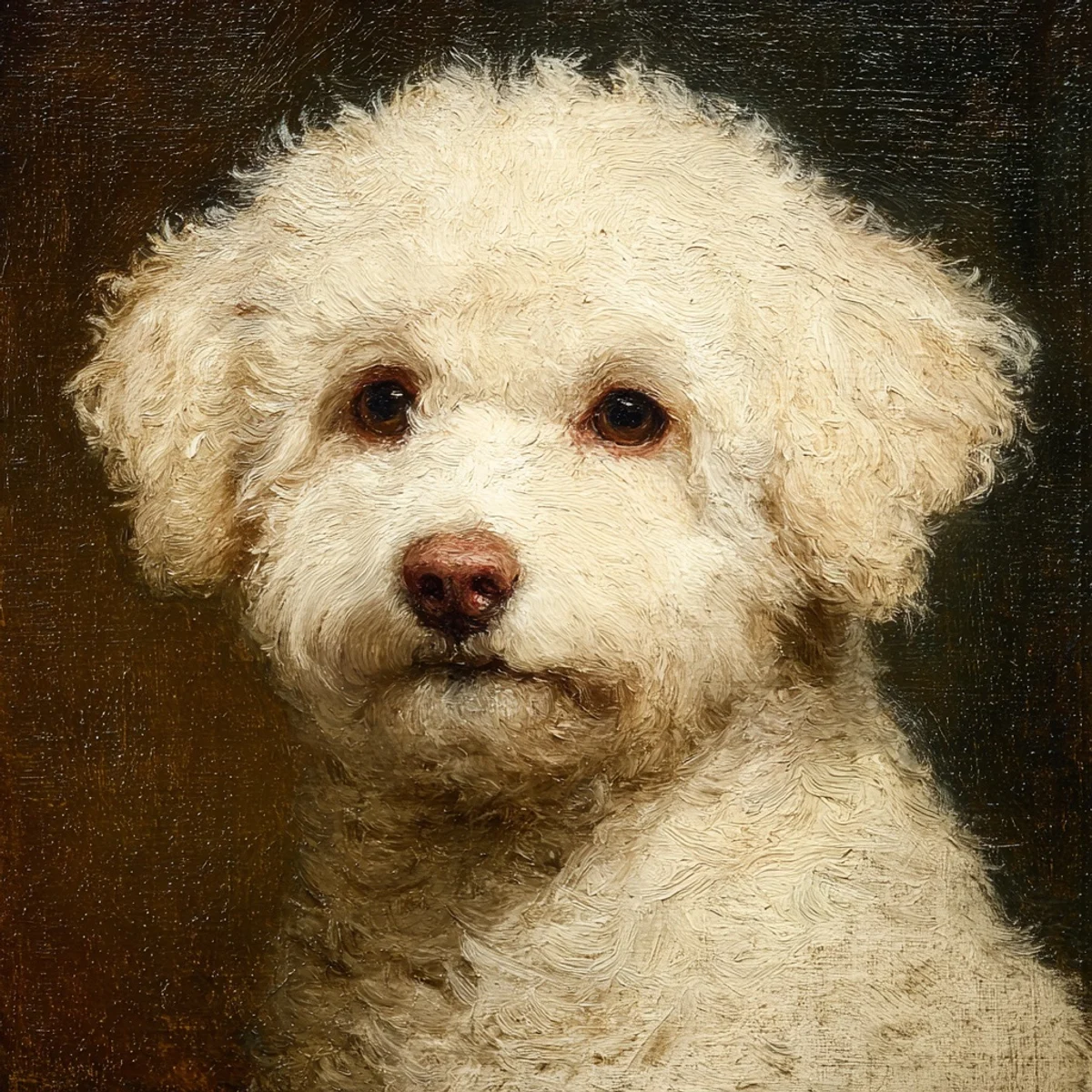
The default pet portrait online in 2026 has a costume. Crimson velvet cape. Gold crown. Sometimes a tiny sword. Sometimes a Sherlock pipe. The genre exists because it's funny - the joke is the dog dressed up like an 18th-century duke.
It's a fine joke. Most people enjoy it the first time. But after the joke has been told a hundred times across every Etsy listing, every Crown and Paw mug, every gift-shop card, the costume starts to read less as charm and more as default-setting. Like the picture frame from Hobbycraft that comes with the photo of a stock-image family already inside.
Some owners want the costume. This article isn't for them. This is for the other category - the owner who wants a portrait of their dog that doesn't require a crown to be charming.
Why "no costume" is a deliberate choice
The traditional fine-art portrait - the kind that hangs in the National Gallery, painted in 1670 - rarely involves the subject in costume. Joshua Reynolds painted aristocrats in their own clothes. John Singer Sargent painted Edwardian women in evening dress, not theatrical regalia. Velázquez painted royalty in court attire, but it was their actual court attire.
The point of those portraits wasn't the costume. The point was the sitter - the face, the bearing, the specific person.
Pet portrait culture inverted this around 2019. The costume became the entire point of the portrait. The dog became a vehicle for the velvet. Crown and Paw, Pet Canvas, Wagsdale - they all primarily sell costume-as-subject.
The alternative, quieter, older tradition still exists. It's what most owners actually want once they spend ten minutes looking at the alternatives side by side.
What "no costume" looks like, technically
A non-costumed fine-art pet portrait still uses the classical compositional rules. The visual language is the same as the costumed version:
- Three-quarter turn (not head-on)
- Asymmetric weight (one shoulder higher, slight lean)
- Soft side-lighting (not flat fill light)
- Eye contact with the viewer
- A restrained background (deep tone, subtle texture)
- Visible brushwork or paint texture
What's different is the absence of:
- A cape, crown, jewelled pendant, military uniform, or other theatrical accessory
- A staged background (a battlefield, a castle library, a renaissance loggia)
- Anachronistic props (a quill, a sword, a smoking pipe)
- The "look how funny this is" caption energy
The dog is the subject. The painting is the painting. That's the whole framework.
The three Olea & Hound styles that do "no costume" properly
Of our six styles, three are explicitly non-costumed and the other three carry varying levels of restraint.
Oil Painting - the centrepiece
Our Oil Painting style is the cleanest "no costume" portrait we make. It sits in the Sargent / Velázquez tradition - contemporary classical, loaded brushwork on a primed-canvas-texture ground, warm directional studio light. The dog is rendered as a sitter. No accessories. No theatrical lighting. No background drama.
If you want a portrait that could hang next to a real painting and not look out of place, this is the one.
Soft Watercolour - the gentle option
Airy, washy, restrained. The composition still follows the three-quarter turn and soft light, but the medium is gentler. Particularly suited to long-haired breeds and to homes that already lean tonal. No costume of any kind - just paint and water and the dog's face.
Minimal Line - the modernist answer
A single continuous ink line. The portrait reduces to the dog's essential silhouette and a few key details. Modern, clean, Scandinavian. The opposite of costume - so reduced that there isn't room for a cape.
This one ranks well above the costumed options for owners with modernist or minimalist homes.
The three more decorative styles
For balance: our Royal Portrait, Storybook, and Memorial styles are all more decorative than the three above. The Royal does include a single restrained costume element (a soft drape or hint of trim - never a full Renaissance regalia outfit). The Storybook leans warm-illustration. The Memorial is restrained but emotional.
If "no costume" is your hard rule, stick to Oil Painting / Soft Watercolour / Minimal Line.
Why the costumed option keeps winning despite this
Crown and Paw, West and Willow, Wagsdale, and the rest of the costumed-portrait shops dominate the market for a clear reason: the costume reads as gift and the no-costume version reads as art.
A costumed dog-in-velvet portrait is a great gift. It's funny, it's instantly recognisable, the recipient says "OH MY GOD" the moment they unwrap it, and it lives on their desk at work for the next year.
A restrained Oil Painting of their dog reads differently. It earns the wall above the mantelpiece. It doesn't trigger laughter when unwrapped. It triggers something quieter and longer-lasting - the recognition that someone made a real painting of the dog.
Different gifts. Different occasions. Different intentions. The costumed portrait is for the person who'd put the dog on a birthday card. The restrained portrait is for the person who'd put the dog on the wall.
Who chooses the no-costume route
Three buyer profiles consistently:
1. The buyer with serious taste in their home
If the rest of your living room is restrained - tonal walls, considered furniture, real art on the walls - a costumed Renaissance-pet-in-velvet portrait won't fit. It'll read as too loud, like a costume party guest who didn't realise the dress code was casual. The Oil Painting or Soft Watercolour reads correctly.
2. The buyer for whom the dog is a serious thing
For owners who genuinely consider their dog the most important relationship in their household - working dogs, service dogs, the dog who got someone through a bad year - the costumed version can feel disrespectful. The restrained portrait honours the dog as a sitter.
3. The owner of a breed that doesn't suit costume
A Greyhound in velvet looks ridiculous, not regal. A Sphynx cat in a crown looks alien, not aristocratic. A Border Collie in court robes looks confused. For these breeds, the no-costume route is the only one that flatters.
The breed-by-breed style guide covers this in detail.
What the quiet portrait does in the room
Two things, mostly.
It signals that the owner has serious taste. Not by being expensive - the file is €39 - but by choosing restraint over noise. The portrait is a marker of judgement, not budget.
And it ages well. The costumed portrait peaks the day it's unwrapped and slowly becomes a fading novelty. The restrained portrait works the same on day one as day three thousand. It doesn't need the joke to keep landing because there was never a joke.
How to commission a no-costume portrait
Upload one photograph of your dog or cat. At the preview stage, you'll see all six styles - including the three quiet ones (Oil Painting, Soft Watercolour, Minimal Line) and the three more decorative ones. The choice is yours; the preview is free; the refund is five-minute.
What we'd ask you to upload, for the best no-costume result:
- A photograph in natural light, ideally near a window
- The dog looking towards the camera but not directly into the lens (a slight side-glance is ideal)
- The dog's face visible above the chest - half-body framing, not just the head
- A relatively plain background (we'll replace it with the style's signature tone anyway, but a busy background can confuse the rendering at the edges)
Three small notes on this style
1. The dog's expression matters more than the costume would have anchored. Without a velvet cape to do the visual work, the face has to carry the portrait. Pick a photo where the dog's eyes are sharp and present.
2. The frame matters more in the no-costume version. A plain dark oak or walnut frame, 25-40mm wide, with a cream or off-white mount, is the standard pairing. The costumed portrait can survive a cheap frame because the velvet does the work. The quiet portrait needs a real frame to land.
3. The print quality matters more. With less visual noise to hide imperfection, the print needs to be good. A2 giclée on Hahnemühle archival paper at any decent local print shop (€20-€35) is the minimum. The €1 home-inkjet print works at A4 but starts to read flat at A3.
Begin with their photograph
Six fine-art styles. Three of them are explicitly no-costume. Free preview before any money changes hands. Refund within five minutes if it isn't them.
The dog is the subject. The painting is the painting. No costume required.