Where to Hang a Memorial Pet Portrait
A practical room-by-room guide to displaying a memorial pet portrait in the home. Which rooms work, which do not, and the framing and placement specifics that make the portrait land rather than intrude.
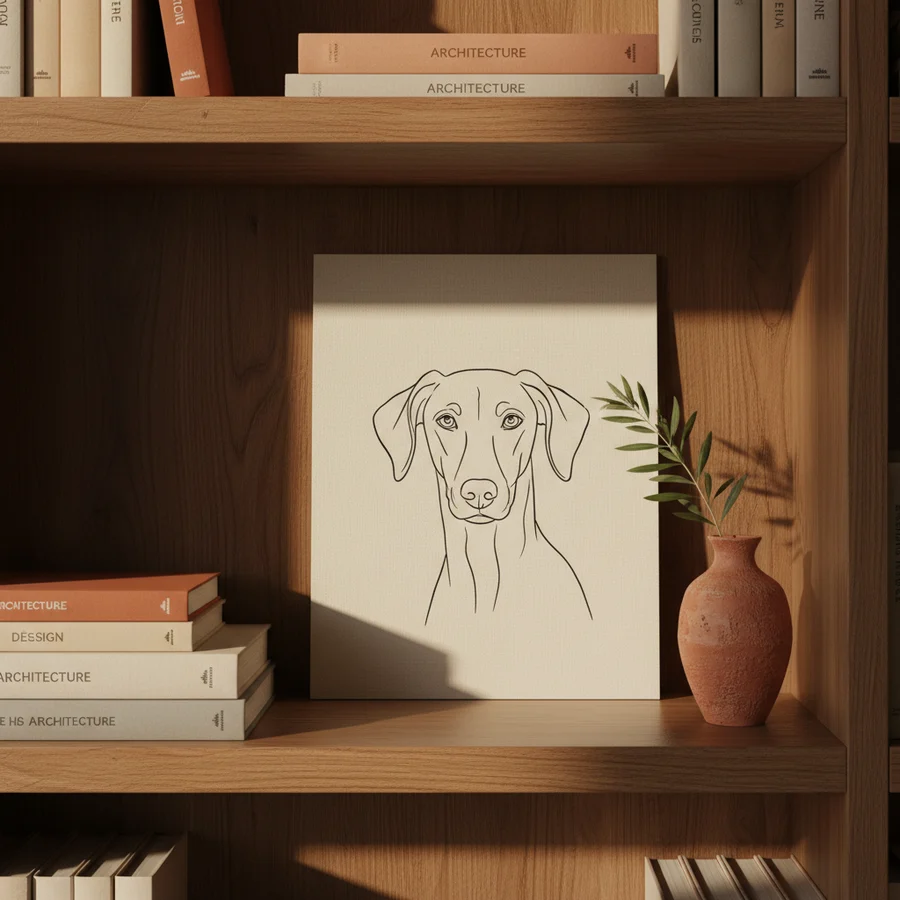
A memorial pet portrait does specific work in a home that other framed pieces do not. It has to be visible enough to honour the pet, but quiet enough that it does not become an emotional ambush every time someone walks into the room. Get the placement right and the portrait becomes part of the household; get it wrong and the portrait either disappears (too tucked away) or dominates (too central).
This is the practical room-by-room guide. We will be specific about what works and what does not.
The framework
Three principles before the room-by-room:
1. Eye-line, not above. Memorial portraits work best at eye-line or slightly below. Above eye-line (over a mantel, high on a feature wall) reads as formal-portrait of an honoured ancestor. That register works for some families and not others. Eye-line reads as part of daily life, which is usually what most owners actually want.
2. Lit by daylight, not by direct sun. The portrait should be where natural light reaches it but where the print is not in direct sunlight (which fades archival inks over years). Indirect daylight from a window on the opposite wall is ideal.
3. Integrated, not isolated. A memorial portrait on a wall by itself, with nothing else around it, reads as a shrine. The same portrait on a wall with other family pieces (other framed photographs, a bookshelf, a side table with personal objects) reads as part of the home. Integrate.
Room by room
The hallway
Verdict: usually yes, but with conditions.
The hallway works if it is wide enough that the portrait is not the first thing visitors see when entering, and if the lighting is decent. A long hallway with a sequence of framed pieces - other family photographs, a piece of small artwork, a mirror - takes a memorial portrait beautifully. The portrait sits as one piece in a sequence, not as the centrepiece of the room.
What does not work: a narrow front hallway where the portrait would be the first thing every visitor sees on the way to the door. The portrait becomes an emotional ambush for the household and an awkward conversational starter for visitors.
Placement specifics: at eye-line, with other framed pieces nearby, in a frame that matches the other frames in the hallway. Not isolated.
The living room
Verdict: yes, but not above the mantel.
The classical instinct is to hang the memorial portrait above the fireplace as a focal piece. This works in a minority of homes - traditional formal living rooms with substantial mantels, in households where the pet was genuinely the centre of family life. In most living rooms it is too much.
The better placement is on a side wall, at eye-line, near other family pieces. The portrait participates in the room without dominating it. Visitors notice it; the family lives with it.
Specifics: dark walnut or natural oak frame, cream mount, A2 or A3 size depending on wall space. Not the only piece on the wall.
The bedroom
Verdict: yes, especially for primary bond.
If the pet was primarily one person's pet (slept on their side of the bed, sat with them in the morning), the bedroom is often the right room. The placement is personal rather than communal; the portrait works for the person whose bond was deepest without imposing on the rest of the household.
Best placement: bedside, on a chest of drawers or a low shelf. A4 or A5 size, in a smaller frame, easel-back or wall-mounted depending on furniture layout.
Avoid: directly facing the bed at eye-line. This puts the portrait in the line of sight every morning, which lands well for some owners and badly for others. Better to place it where it is visible but not directly addressed.
The kitchen
Verdict: usually no.
The kitchen is a working space and a high-humidity environment. Memorial portraits in kitchens tend to read as out of place - the room is too busy with cooking, eating, and household admin to give the portrait the breathing room it needs.
The exception: a quiet breakfast room or a small dedicated dining alcove where the table is calm in the mornings and the room is not the primary cooking space. In these spaces a smaller framed portrait on a side wall can work.
Avoid: directly above the kitchen counter, near the sink, near the cooker. Steam and cooking oil will damage the print over years.
The dining room
Verdict: rarely.
A formal dining room that is used for occasional dinners can take a memorial portrait, but a dining room used for daily family meals usually cannot. The portrait becomes the visual centre of every meal, which is too much.
If you have a formal dining room used four or five times a year, the portrait can hang on a side wall and read as part of the room's formality. For everyday dining spaces, choose a different room.
The home office
Verdict: yes if the owner worked from home with the pet.
If the pet was a fixture of someone's working day - sleeping under the desk, curling on the office chair - the home office is often the most fitting room. The portrait sits in a space the owner uses daily for hours, in a register that suits long-term contemplation.
Best placement: on the wall opposite the desk, at slightly above eye-line when sitting (so you look up at the portrait between tasks rather than directly across at it). A4 or A3 in a simple frame.
The bathroom
Verdict: no.
Humidity, splash exposure, and the register of the room (functional, not contemplative) all argue against. We have seen exactly one bathroom placement that worked - a guest bathroom with a long shelf displaying framed family pieces - but it is the exception.
The garden
Verdict: separate category - this is for outdoor memorial plaques, not framed portraits.
Framed paper or canvas portraits do not belong outdoors. UV fades the print within a season; humidity warps the frame within two. If you want an outdoor memorial, commission a metal or stone plaque from a separate vendor - we do not provide this.
That said, an indoor framed portrait near a window that looks out onto the garden the pet used is a meaningful placement. The portrait is indoors and protected; the visual connection to their outdoor space is intact.
A staircase landing
Verdict: often the perfect placement.
A staircase landing - the half-floor between rooms on the way up or down - is one of the most underrated placements for any portrait, including memorial. The landing is passed multiple times a day but is not a room where anyone stays. The portrait gets daily acknowledgement without becoming the centre of any space.
Best placement: at the top of the stairs, at eye-line as you reach the landing. A2 or A3 size. Frame matches whatever framing logic exists in the rest of the house.
Frame and mount specifics
Memorial portraits have slightly different framing rules than the formal Royal or Oil Painting framing we cover elsewhere.
Frame: dark walnut or natural oak, 25-30mm wide. Not the wider 40-50mm dramatic frames that work for Royal Portrait. The memorial frame should be present but unobtrusive.
Mount: cream or off-white double mount, 60-80mm border. Wider mount than other styles - the breathing room around the portrait is part of the emotional register.
Glazing: matte non-reflective glazing if the room has variable light. Standard clear glass is fine for low-light rooms.
Hanging hardware: wire-hung or D-rings, not adhesive strips. Memorial portraits stay in place for decades; the hanging should be substantial.
When the portrait should move
A note that is rarely written. Memorial portraits do not always stay in the same place forever. Three reasons to move one:
1. The household evolves. A pet who was central to a family with young children may belong in a different room after the children have grown and moved out.
2. A new pet arrives. When a new dog or cat joins the household, the memorial portrait sometimes needs to move so that the new pet has space to be themselves. The old portrait does not need to be put away - it just needs a quieter room.
3. The owner moves house. Memorial portraits transfer well between homes. The portrait is not tied to a specific wall; it is tied to a specific bond. Most owners find they want the same portrait in their new home, and the placement question starts over.
What size for which placement
A quick reference:
- Main feature wall: A2 (594 × 420 mm) framed to A1 size with mount
- Side wall in a larger room: A2 framed to A1 with mount, or A3 framed to A2 with mount
- Hallway: A3 framed to A2 with mount
- Bedside or shelf placement: A4 framed to A3, or A5 framed to A4
- Home office wall opposite desk: A3 framed to A2
A2 is the most common size we recommend. A3 is the second. A4 and smaller suit shelf or bedside placement.
Frequently asked questions
How long after the loss should I hang the portrait?
There is no rule. Most owners hang the portrait 2-8 weeks after commissioning it (which is usually 1-4 weeks after the loss). Some wait longer; some hang immediately. The decision belongs to the person grieving.
Should I hang multiple memorial portraits if I have lost multiple pets?
Yes, and the grouping matters. Two memorial portraits side by side at eye-line on the same wall read as a family. Three or more start to read as a gallery. The grouping is fine; just be aware that more than three becomes a memorial wall rather than an integrated family display.
What if I move house?
The portrait moves with you. The placement question starts over in the new house. Most owners find a similar placement in the new home (hallway, bedroom side wall, staircase landing) feels right.
Is it okay to put the memorial portrait away in a drawer if it becomes too much?
Yes. Some owners find that after a year or two, the portrait belongs in a drawer or on a closet shelf rather than on a wall. This is a normal stage of the grief process and the portrait can be re-hung later or kept in storage as a family object rather than a daily presence.
Can a memorial portrait become a non-memorial portrait over time?
Yes. Many owners find that ten or fifteen years after the loss, the memorial portrait simply becomes a portrait - one of the dogs or cats they have loved across their lifetime. The grief recedes; the portrait remains. This is part of why we recommend hanging it as an integrated piece rather than as an isolated shrine. The placement is built for the long game.
What if I commissioned a memorial portrait but I do not have a wall I want to hang it on?
Then it lives on a shelf, a chest of drawers, or a bedside table. The framed easel-back placement is just as valid as the wall hang, and for some homes it is the more honest choice.
Begin with their photograph
Upload one photograph and see the Memorial style alongside the other five. Free preview, refund within five minutes if it isn't them.
The portrait is the easy part. The placement is the part that takes patience. Most owners find the right wall within a month of hanging it for the first time, sometimes by moving the portrait once or twice before it settles. The portrait will tell you when it has found its room.