Why Renaissance Dog Portraits Quietly Took Over the Internet
How the dog-in-velvet-cape aesthetic went from absurd to ubiquitous, what it says about taste in 2026, and why it might be the best style for your dog too.
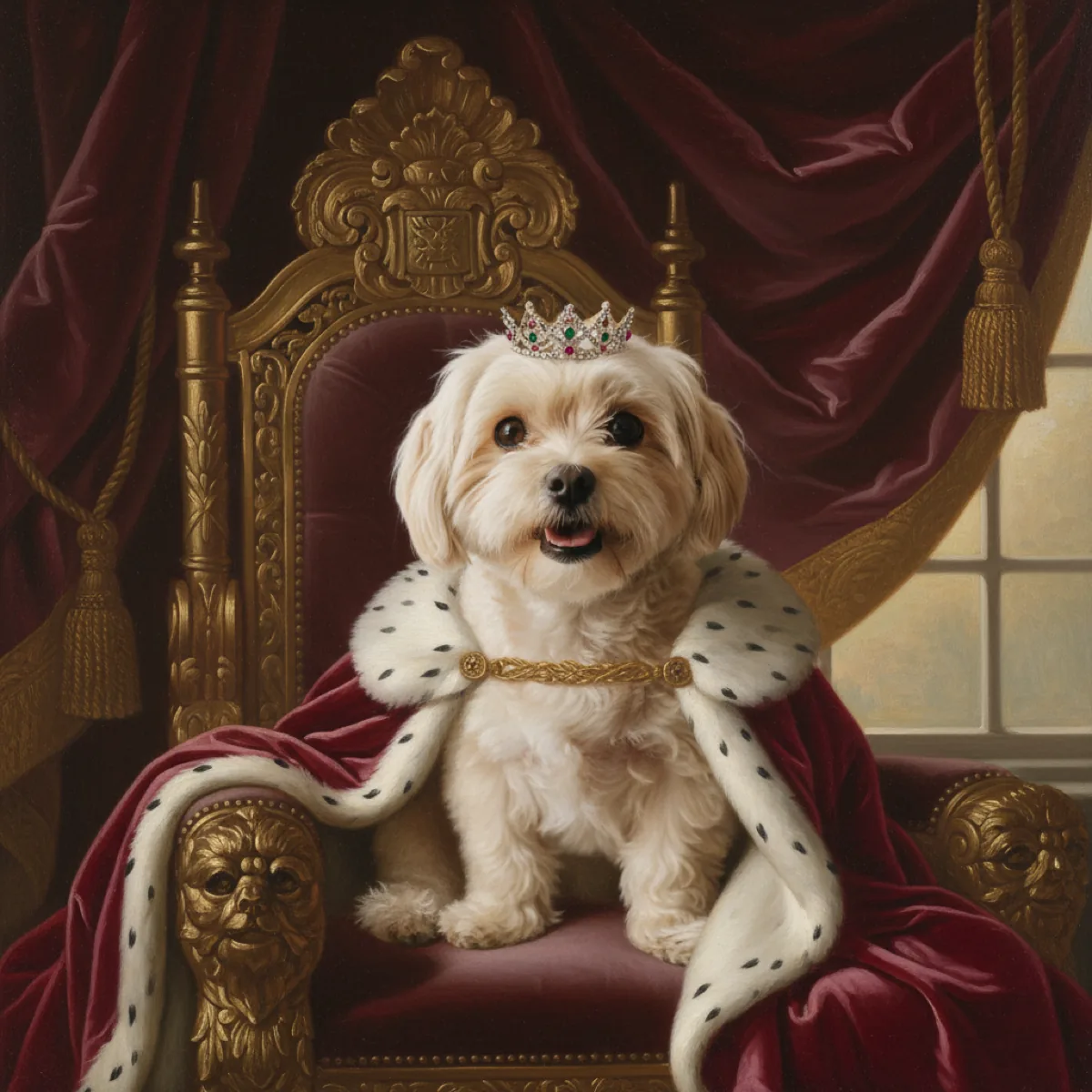
There is now a category of internet image so well-established that it doesn't need explanation. You see a dog, you see a crimson velvet cape, you see a small jewelled crown, and your brain files it instantly under "I know what this is".
In 2018 this would have been called absurd. In 2026 it's hung above sofas in three continents. The Renaissance dog portrait has, quietly, become one of the most replicated aesthetics on the consumer internet - and it's worth understanding why before you commit to it for your own dog.
The history is shorter than you think
The trope traces back to Crown and Paw, an Etsy store that launched the modern version of this in 2019. Within eighteen months the category had a dozen imitators. By 2022 you could buy a "renaissance pet portrait" from a hundred different sellers in a hundred slightly different visual dialects. By 2024 it had migrated from novelty to gift-shop staple.
What's interesting is that the actual visual vocabulary - the crimson velvet, the gilt thread, the chiaroscuro lighting - is much older than the meme. It comes from a real period in court portraiture: roughly 1670 to 1780, the work of painters like Joshua Reynolds, Thomas Gainsborough, and a long list of Continental court painters whose names didn't survive but whose framing conventions did.
The internet didn't invent the Royal Portrait look. It inherited it from European court painters and applied it to dogs - which, it turns out, is exactly the sort of irreverence the genre needed.
Why it works as a portrait
The reason this style keeps winning, three centuries after it was invented:
1. It flatters every breed.
A wolfhound in court regalia reads as noble. A pug in court regalia reads as comedic. Neither result is wrong - and that range is rare in a style. You can put almost any dog in this aesthetic and get a portrait that is either grand or charming, never awkward.
2. The lighting hides the dog's bad-photo day.
A serious oil-painted portrait depends on the underlying photograph being well-lit. The Royal Portrait style introduces its own dramatic side-lighting, which masks an unflattering source photo. The dog you photographed at 11pm under a kitchen ceiling-light becomes a dog backlit by candle and window in oils.
3. It signals "fine art" without actually requiring fine art.
The visual language - velvet, gold thread, soft chiaroscuro - is so heavily associated with museum walls that even a quick rendering reads as "elevated" to the viewer. The frame on your hallway wall does some of the work; the style does the rest.
4. It photographs well on phones.
The high-contrast composition - dark background, illuminated subject - holds up at thumb-size on Instagram. Soft Watercolour gets compressed by social-platform algorithms; Royal Portrait survives.
Why it stops working
Two failure modes worth flagging.
When the dog has soft features.
A Cockapoo, Bichon, Maltese, or Pomeranian in full court regalia can tip from charming to fancy-dress. The style's gravitas competes with the dog's softness. For these breeds, Soft Watercolour or Storybook usually flatter more.
When the room is already busy.
The Royal Portrait carries visual weight. In a minimalist room it anchors; in a busy room it shouts. If your home is gallery-wall heavy or has strong wallpaper, consider Minimal Line - same dog, quieter painting.
What separates a good Renaissance dog portrait from a forgettable one
Spend ten minutes browsing the genre and you can rank quality by three signals:
1. The eyes. The single hardest thing to render is the dog actually looking at you. Cheap versions of this style have unfocused eyes, like the dog is mid-blink. The right version has eyes that meet yours from across the room.
2. The fur edge against the velvet. Where the dog's coat meets the dark background, you can tell the quality immediately. Bad renderings have a hard, cut-out edge. Good ones have soft transitions where the fur catches the light.
3. The composition fitness. Bad versions place the dog too low in the frame, or facing dead-on like a passport photo. Good versions follow the conventions of 18th-century portraiture: three-quarter turn, eyes meeting the viewer's, weight asymmetric.
What "good enough to hang" actually looks like
If you've seen ten Crown and Paw clones on Etsy and felt vaguely disappointed, this is probably why - many of them are rendering versions of the style without the underlying composition rules, and the result is a dog with a costume rather than a dog in a portrait.
Our Royal Portrait follows the original 18th-century framing conventions. Three-quarter turn, asymmetric weight, soft side-lighting, eye contact with the viewer. It's the difference between an Etsy mug graphic and something that earns a frame.
Pairings: dog + style + room
A short table for the people thinking ahead to the wall, not just the file.
| Where it will hang | Frame style | Mount colour | Print size |
|---|---|---|---|
| Hallway above console | Antique gold, ornate | Cream double | A2 |
| Sitting room above mantel | Walnut, simple | Off-white | A2 or A1 |
| Bedroom side table | Plain black wood | None | A4-A5 |
| Home office, eye-line | Thin gold metal | Cream | A4 |
| Stairwell gallery | Mixed-style cluster | White | Varied A3-A4 |
The version we'd commission
If you only ever commission one Royal Portrait of your dog, the brief is:
- A three-quarter turn, not a head-on stare
- The dog wearing a single restrained accessory (cape or chain - not both), in a colour that complements the dog's fur
- A dark, slightly textured background, not pure black
- Soft side-lighting, no halo
- A medium-size frame in antique gold, A2 print, cream mount
That's the configuration that earns a wall and keeps it.
Begin with their photograph
Upload one photo of your dog and you'll see what they look like in the Royal Portrait style - alongside five other considered styles - in thirty seconds. Free preview, no shipping, refund within five minutes if it isn't them.
The style is three hundred years old. Your dog deserves a turn.