Pet Loss Gifts That Don't Feel Like Pet Loss Gifts
A restrained guide to gifts for someone who has lost a dog or cat. What lands, what fails, and why the plaque-and-urn category is overrated.
Most pet-loss gift guides on the internet are written for the buyer, not the bereaved. They are listicles of twenty-five items, optimised for affiliate revenue, sorted by Amazon availability. The "best" pet loss gift always turns out to be whichever urn the writer was paid the most to feature.
This is not that guide. We have spent the last year talking to owners who lost dogs and cats, asking what landed, what didn't, and what they wish people had given them instead. The pattern is clear, and most of the standard pet-loss gift category is wrong.
The standard pet-loss gift category is mostly wrong
A short summary of what the top affiliate listicles recommend, and what owners actually told us about each:
- Cremation urns. Most owners already have one from the vet. Receiving a second one is awkward.
- Memorial plaques for the garden. Owners who have a garden usually want to choose the plaque themselves. Receiving one chosen by someone else is well-intentioned but rarely fits.
- Custom jewellery with the pet's name engraved. Polarising. Some owners love it and wear it. Others feel it veers into goth territory. Hard to predict in advance.
- Cremation jewellery (containing a small amount of ashes). Very personal. Should only be commissioned by the owner themselves, not given as a gift.
- Paw-print resin keychains. Cheap, mass-produced, awkward to receive.
- A photo book of the pet. Excellent if you actually knew the dog or cat well and have photographs. Bad if it is made from photographs you found on Facebook.
- A donation to a pet rescue. Genuinely good, especially if the owner adopted from a known rescue. See below.
- A framed photograph from a photo you took yourself. Good, but you need a photograph that is actually worth framing.
Most of the affiliate-listicle category sits in the polite-but-forgettable middle. The gift gets unwrapped, the recipient says thank you, and the item ends up in a drawer.
What actually lands
Three categories that owners told us they kept, used, or remembered. Each one is a thing that survives the first week.
1. A handwritten note that names the pet
The single highest-impact pet-loss gift is the most analogue one. A handwritten note, on paper, that names the dog or cat specifically and says one specific thing you remember about them.
Not "thinking of you." Not "so sorry for your loss." Something specific: "I remember when Luna learned to use the cat door backwards." Or: "Murphy was the only dog I ever met who could open the fridge."
Owners told us they kept these notes in the drawer with the pet's collar. They re-read them years later. The handwritten note is the gift that stays.
Cost: €0 plus a stamp. Effort: ten minutes. Impact: the largest of anything on this list.
2. A donation in the pet's name to the specific rescue they came from
If you know the rescue or shelter the pet was adopted from, donate in the pet's name. €30-€100 is enough. The rescue will send a personalised thank-you card; the owner keeps the card; the gift continues to do work for other rescue animals.
This works because it is specific to the pet (you knew the rescue) and because the impact compounds. The €50 you donated in Murphy's name might cover three weeks of food for the next rescue dog.
Cost: €30-€100. Effort: five minutes online. Impact: very high if you knew the specific rescue.
3. A framed portrait, but only if commissioned at the right moment
This is our category, so we will be specific about when it works and when it doesn't.
A framed portrait works as a gift if:
- You knew the pet personally (not just from the owner's social media)
- The owner has not already commissioned a memorial portrait themselves
- You can wait 1-2 weeks before giving it
- You frame it properly (A2 size, dark walnut frame, cream mount) - not in a clip frame from a supermarket
- The owner's home is the kind of home that has art on the walls (some homes are not, and a portrait will not land in the right register)
It does not work if:
- The owner is in the first week after the loss (too raw)
- You found a low-resolution photograph on Facebook and used it without asking
- You commissioned it without telling the owner (some owners want to choose the photograph themselves)
- The pet has been gone for more than two years (the moment for the gift has passed)
The right way to commission a memorial portrait as a gift is to ask the owner first. "I would like to commission a portrait of Murphy as a way of marking what he meant. Would you choose your favourite photograph and send it to me?" This sidesteps the awkwardness of using a photograph the owner did not approve, and ensures the portrait is what they actually wanted.
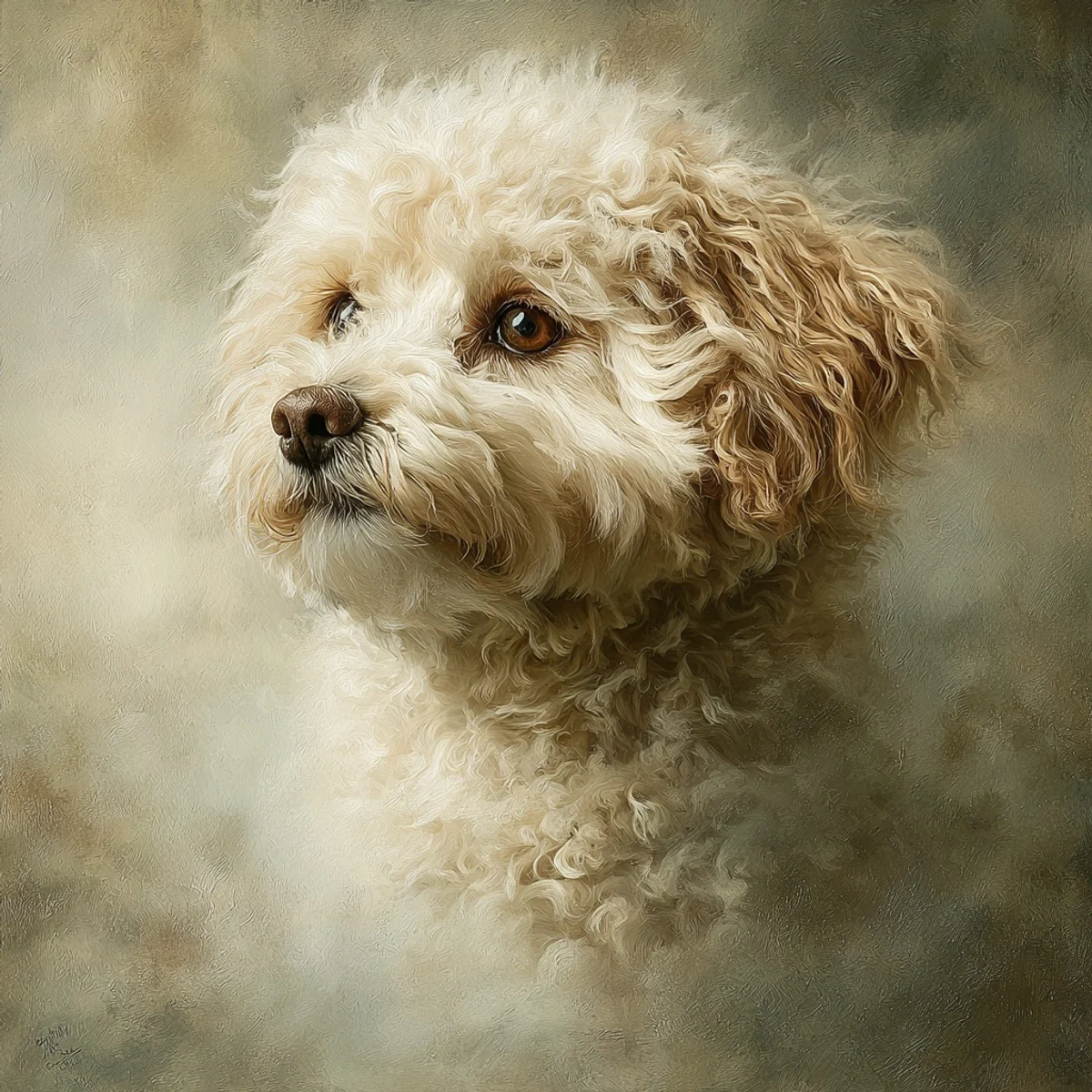
Our Memorial style is built specifically for this use case. €39 for the digital file, €25-€35 for an A2 fine-art print at a local print shop, €40-€80 for a real wooden frame. Total: €100-€135 for a framed memorial portrait. Less than the cost of a mid-range urn and more likely to end up on a wall.
Three smaller things that work
These are not headline gifts. They are quiet additions to one of the three above, or stand-alone if a smaller gesture is more appropriate.
A meal delivered to their house
Loss tires people. Cooking the day after a pet dies feels impossible. A pre-cooked meal delivered to their door - a casserole, a soup, something they can reheat - is small but useful. Doubly good if the meal was something the pet would have stolen.
A specific memory shared in conversation
Not a gift in the material sense. A conversation that names something specific the pet did. "Do you remember when..." Owners told us these conversations stayed with them longer than most of the physical gifts they received.
A book about grief, but specifically about pet grief
Most grief books treat pet loss as a footnote. The exceptions: The Loss of a Pet by Wallace Sife, Goodbye, Friend by Gary Kowalski. These are respectful, secular, and useful. A copy with a handwritten inscription works as a gift; a bare copy without inscription does not.
What to absolutely avoid
A short list of mistakes we have seen go wrong:
- A new pet of the same breed. Almost universally a mistake. Even if the owner says they want another dog eventually, it is for them to choose.
- A cremation urn if the vet already provided one. You will not know whether they did. Default to assuming yes.
- A "rainbow bridge" themed item. The rainbow bridge poem is divisive. Some owners find it comforting. Others find it twee. Hard to predict.
- A photograph montage video. These age badly and most people watch them once.
- Anything that requires the owner to do something (a memory journal to fill in, a DIY memorial kit). They are grieving. They do not need a project.
On timing
The timing for pet-loss gifts is meaningful. A short framework:
- Days 1-7 after the loss. Send the handwritten note. Deliver a meal if you are close. Do not commission anything elaborate yet - the owner is in shock and cannot fully receive a major gift.
- Weeks 2-4. The good window for the framed portrait or the donation. The acute grief has lifted enough to receive a considered gift; the loss is still recent enough that the gift lands meaningfully.
- Months 2-6. Smaller gestures work. A book, a meal, a conversation. The framed portrait can also work here if it was not given earlier.
- Year 1 anniversary. The handwritten note works again at this point. So does a donation in the pet's name. The framed portrait, if not yet given, is still appropriate.
- Year 2+. Most gifts at this point feel like reopening the wound. Stick to gestures (a meal, a conversation) rather than physical items.
Frequently asked questions
Is it okay to give a memorial portrait without asking first?
We generally recommend asking, especially for the choice of photograph. The owner usually has a specific photograph they want commemorated, and using a different one (even a beautiful one) can feel like a misstep. The exception: if you are a partner or family member and you genuinely know the photograph the owner would choose.
How long should I wait before giving a memorial gift?
The 2-4 week window is the sweet spot for substantive gifts (portrait, donation). For the handwritten note, send it immediately.
What if I did not know the pet personally?
The handwritten note works regardless. A donation in the pet's name works regardless. A framed portrait does not - if you did not know the pet, the gift feels presumptuous. Stick to the first two.
Is it appropriate to give a memorial gift for a cat?
Yes. Everything on this guide applies to cats. The Memorial style page and cat portrait line both work for cat memorial portraits.
What if the owner has already commissioned their own memorial portrait?
Then a portrait gift is duplicative. Switch to the donation or the handwritten note. Or commission a portrait in a different style as a complement - if the owner has the Memorial style, you might commission the Soft Watercolour or Oil Painting style as a more celebratory alternative.
Can a memorial portrait be commissioned of a pet who passed away years ago?
Yes. Many owners commission memorial portraits a year or two after the loss, sometimes longer. The portrait is for the surviving person more than for the pet, and people come to that gift on their own timeline.
Begin with their photograph
Upload one photograph of their pet and see the Memorial style alongside the other five. Free preview, refund within five minutes if it isn't them.
Pet loss gifts are not really about the gift. They are about the person. The handwritten note. The specific memory. The donation in the pet's name. The framed portrait, when the timing is right and the photograph is right.
The plaque-and-urn industry is overrated. The note in the drawer is underrated. Most of the work is showing up.