Your Puppy's First Portrait - When and How
A milestone timeline for commissioning a puppy portrait. When to take the photograph, which style suits which puppy age, and why the first year produces the most meaningful pieces.
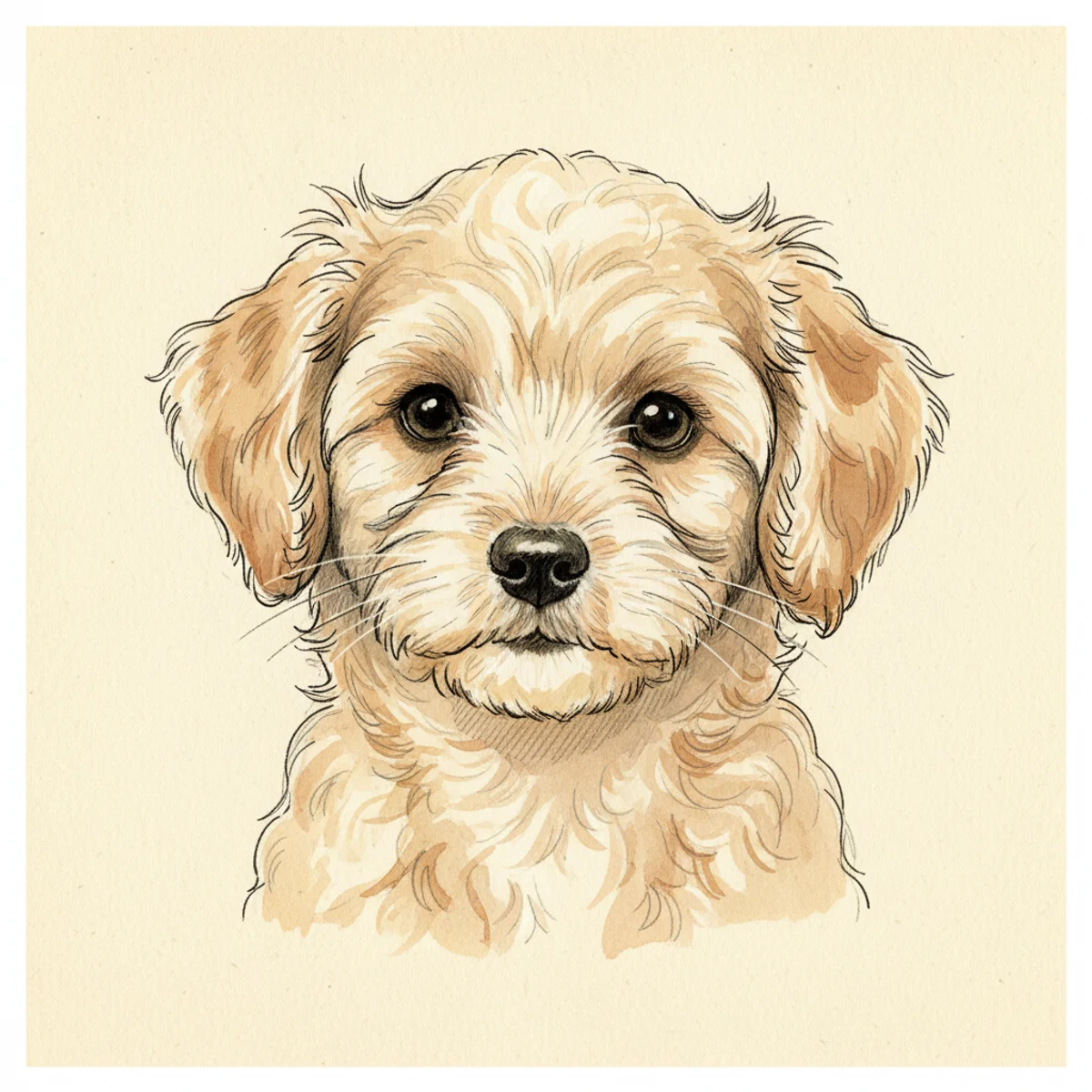
The first year of a puppy's life changes faster than any other year they will have. The dog you bring home at 8 weeks looks materially different at 16 weeks, looks different again at 6 months, and is barely recognisable at 12 months as the same animal. Most owners take hundreds of phone photographs across this year and rarely turn any of them into a real wall piece.
The puppy portrait window is short and worth taking seriously. This is the milestone timeline for when to photograph and what to commission.
Why the first year matters
A short observation: most pet portraits we render are of adult dogs and cats. Owners commission the portrait once the pet is "established" - usually 2 to 8 years old, when they have settled into themselves and the bond is clearly long-term. This is reasonable. It is also a mistake to wait that long for the first portrait.
The puppy face never comes back. The fluffy uncertain ears, the slightly-too-big paws, the soft uncoordinated movement - all gone by 12 months. A portrait of the dog at 6 months captures a creature who will not exist again. A portrait of the same dog at 4 years captures who they have become, which is also valuable but is a different piece.
Most owners commission one or two portraits across a dog's life. We recommend at least one of them be from the first year.
The milestone timeline
A specific schedule with photograph and portrait recommendations at each stage.
8-12 weeks (first month home)
What's happening: The puppy is acclimating to your home. Sleeping 18-20 hours a day. Tiny relative to adult size. Coat is still puppy-soft, often with markings that will change.
Photograph: Take a lot of photographs but do not commission a portrait yet. The first month is for observation and bonding, not for production work. The dog is changing too fast for a portrait to capture.
What to capture: Sleeping puppy, puppy with a favourite toy, puppy looking out a window. Lots of phone photographs. They will be useful later.
12-16 weeks (the puppy face peak)
What's happening: The classic puppy proportions are in full effect. Big paws, soft features, slightly disproportionate ears. Often the most photogenic stage.
Photograph: This is the prime window for the first portrait. The dog still looks like a puppy but is settled enough to sit calmly for a photograph. Take 30-50 photographs over a single morning in window light.
Style recommendation: Storybook or Soft Watercolour. The Storybook style is built for young animal character; Soft Watercolour catches the softness of puppy coat texture beautifully. Royal Portrait and Oil Painting do not work as well at this age - the formal compositions read as ironic on a puppy face.
When to commission: Right now, or within 2-4 weeks of taking the photograph. The dog will change between photograph and commission if you wait too long.
4-6 months (adolescent stretch)
What's happening: Adolescent growth spurt. The puppy gets leggy, sometimes a bit gawky. Adult coat starts replacing puppy coat. Often a more energetic and harder-to-photograph period.
Photograph: Optional middle-window. Some breeds (Cavaliers, Labradors, working line shepherds) photograph beautifully in this stretch; others (Border Collies, Greyhounds, taller leggier breeds) go through an awkward phase.
Style recommendation: If you do commission at this age, Storybook works best. Avoid the formal styles.
6-9 months (transitional)
What's happening: The dog is roughly adult-sized but still has puppy character in the face. Coat is largely adult but with some puppy-coat tufts remaining. Personality is forming.
Photograph: Excellent secondary window. The dog has settled enough to sit for a proper sitting but still has youthful character.
Style recommendation: Any style works at this age, depending on breed character. Soft Watercolour for soft-coated or gentle dogs. Royal Portrait for working-line dogs with adult posture. Storybook for charm-led dogs.
9-12 months (the first true adult portrait)
What's happening: The dog has reached adult proportions and adult coat. The face has settled into roughly what it will look like for the next 5-7 years.
Photograph: This is the window for the first formal adult portrait. The puppy character is gone; the adult character is in.
Style recommendation: Whichever style suits the adult dog. Royal Portrait for dogs with bearing. Oil Painting for dogs with strong individual character. Soft Watercolour for gentle long-coated dogs.
When to commission: Many owners commission a second portrait at this stage as the formal "this is who they are now" piece, complementing the puppy portrait from 12-16 weeks.
12+ months (adult life)
The dog is fully adult. Portraits from this stage onward represent the established adult character. Standard adult portrait recommendations apply.
Which style for which age
A summary table:
| Age | Storybook | Soft Watercolour | Oil Painting | Royal Portrait | Memorial | Minimal Line |
|---|---|---|---|---|---|---|
| 8-12 weeks | ✓ | ✓ | - | - | - | - |
| 12-16 weeks | ✓✓ | ✓✓ | - | - | - | ✓ |
| 4-6 months | ✓✓ | ✓ | - | - | - | ✓ |
| 6-9 months | ✓ | ✓✓ | ✓ | ✓ | - | ✓ |
| 9-12 months | ✓ | ✓✓ | ✓✓ | ✓✓ | - | ✓✓ |
| 12+ months | ✓ | ✓✓ | ✓✓ | ✓✓ | - | ✓✓ |
✓✓ = particularly well-suited. ✓ = works. - = avoid at this age.
How to photograph a puppy for a portrait
Puppies are harder to photograph than adult dogs because they do not sit still for as long. A short procedure:
- Time the photograph after a meal or after exercise. The puppy will be tired and calmer.
- Set up indoors in window light. North or east-facing window, mid-morning.
- Place the puppy on a chair, low sofa, or large cushion. This stops them from running around and gives a stable base.
- Have a treat or favourite toy held just above and behind your phone. The puppy looks toward the treat, which produces a slight off-camera gaze.
- Use burst mode. Take 30-50 photographs in rapid succession. Puppies move; you will need to filter heavily.
- Stop after 5 minutes regardless of how many photographs you have. Puppies have short attention spans. A second session 2-3 days later will produce better results than continuing past 5 minutes.
Most puppy portraits we render come from photographs taken between 10am and noon on a weekend morning, in window light, indoors. The conditions matter more than the photographer's skill.
How many puppy portraits to commission
A defensible rhythm for the first year:
- One portrait at 12-16 weeks. Storybook or Soft Watercolour. The classic puppy piece.
- Optionally one at 9-12 months. Oil Painting or Royal Portrait. The "first adult" piece.
Two puppy portraits across the first year is the upper bound. Three becomes excessive. One is enough if budget or wall space is constrained.
What about portraits that include the owner and the new puppy?
Excellent use case. Many owners commission a portrait of themselves with the new dog as a kind of arrival photograph. Upload one image of you holding the puppy, or sitting with them on a sofa, and we compose the portrait with both subjects. No additional cost for the second subject.
The owner-with-puppy portrait works particularly well in Storybook or Soft Watercolour style.
Cat owners - the same principle
Cats kittens follow a similar but shorter timeline. The "kitten face peak" is roughly 8-14 weeks; the transition to adult is largely complete by 9-12 months for most breeds. Commission a kitten portrait between 10 and 14 weeks if you want one.
Our cat portrait line renders all six styles for cats. Storybook and Soft Watercolour are the recommended kitten styles.
Frequently asked questions
Should I wait until the puppy is fully grown before commissioning a portrait?
No. The puppy stage produces meaningful portraits that the adult stage does not. Commission at least one piece during the first year.
What if I missed the 12-16 week window?
The 6-9 month window is the second-best. Commission then if you missed the earlier window. The 9-12 month window produces a more adult-looking piece but still captures some of the youth.
How long does the rendering take?
Approximately 30 seconds, same as adult dog portraits.
Can I order multiple styles to compare for my puppy?
Yes. The €69 three-style tier or €99 all-six tier lets you see Storybook, Soft Watercolour, and other styles applied to the puppy. Most owners are surprised by which style works - what looks right in theory often does not survive contact with the actual puppy face.
What if my puppy is a rescue and I do not know their exact age?
Estimate based on size and tooth development relative to the breed. The vet can usually give a 2-4 week age estimate. The style recommendation still works on a "puppy character" basis rather than a precise age.
Does the puppy portrait need to be framed at small size?
A2 works at any age - the formal large piece. A3 or A4 also works, particularly for bedside or nursery placement. Puppy portraits suit slightly smaller framing more often than adult portraits because the subject scale is smaller.
Can a puppy portrait include the puppy with their toy or blanket?
Yes. If the photograph shows the puppy with a specific favourite toy, the rendering will include it. This works particularly well in Storybook style.
Begin with their photograph
Upload one photograph and see all six styles in 30 seconds. Free preview, refund within five minutes if it isn't them.
The puppy year is short. The portrait of who they were before they grew up belongs on the wall regardless of whether you commission another portrait at 4 years old. Storybook or Soft Watercolour, between 12 and 16 weeks, in window light. That is the prime window.