Royal Dog Portraits - The Restrained Guide
The case for restraint over costume in the royal dog portrait category. What the European court tradition actually looked like, which dogs suit the style, and how to commission a genuinely regal piece without the velvet-cape kitsch.
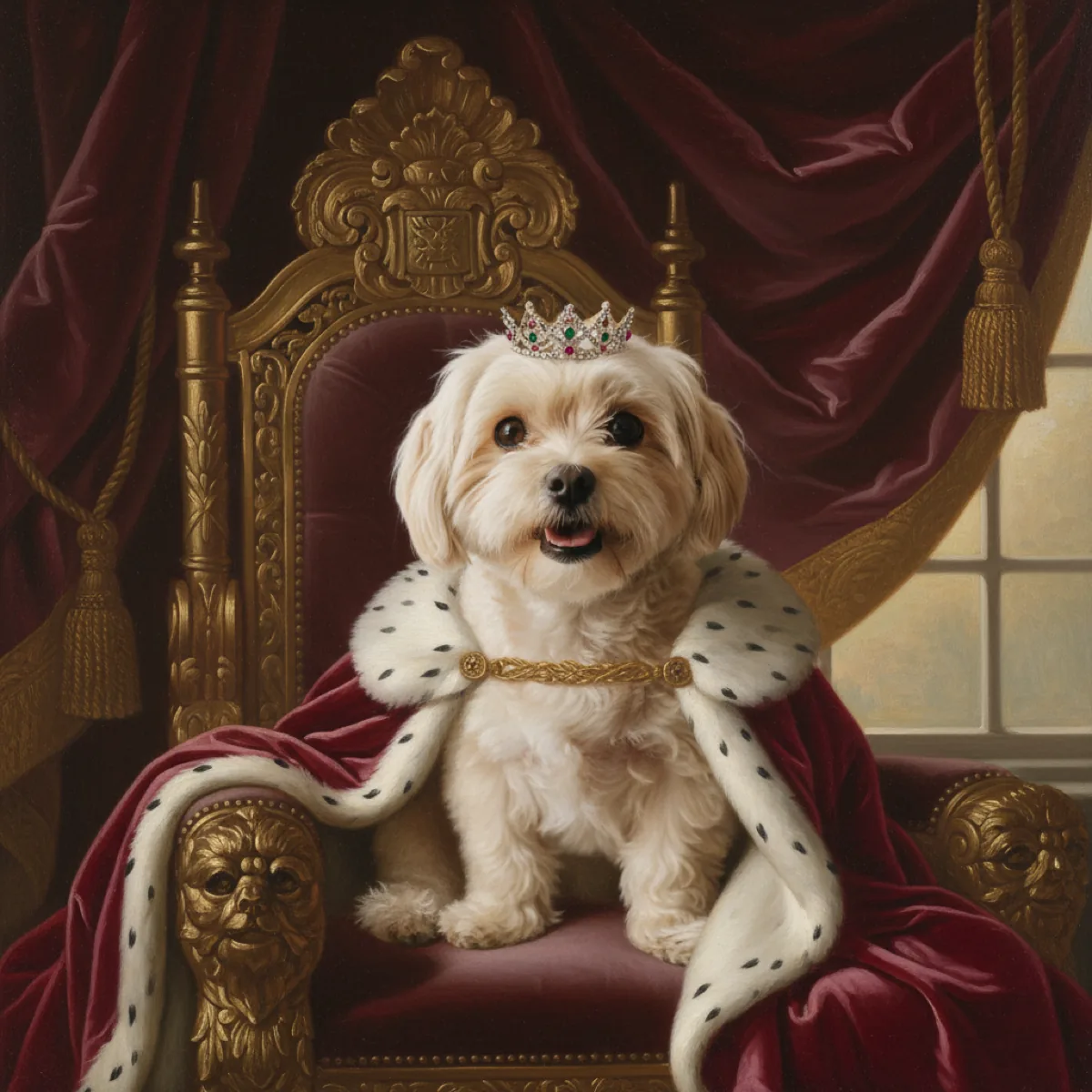
The "royal dog portrait" category in 2026 is dominated by costume. Search the term and you get pages of dogs in velvet capes, dogs in jewelled crowns, dogs in tiny suits of armour, dogs holding swords. The genre exists because it sells - the joke is the dog dressed up like an 18th-century duke.
It is a fine joke, the first time you see it. After the hundredth velvet cape it becomes the visual equivalent of a Christmas cracker hat. The costume is doing all the work; the dog is incidental.
There is an older tradition, and a quieter one. The royal dog portraits that hang in the National Gallery and the Prado were not built around costume. They were built around bearing. This is the guide to commissioning a royal dog portrait in that tradition.
What "royal" actually meant in court portraiture
A short history. From roughly 1500 to 1850, royal portraits across Europe followed a tight set of compositional rules:
- The sitter, three-quarter turned. Never head-on. Never full profile. Always a slight angle, one shoulder higher than the other.
- Soft directional light from one side. Almost always a single window light. The face is half-lit, half in shadow. Catchlight in the eyes.
- A dark, deep background. Not patterned. Not staged. A simple gradient from dark to slightly less dark, often with a hint of a curtain or a column.
- A neutral or subtle wardrobe. Court dress when relevant. The wardrobe served the sitter, not the other way round.
- No theatrical props. Occasionally a book, a glove, a small object that signified status. Never a sword unless the sitter was a soldier. Never armour unless the sitter actually wore it.
The Velazquez portrait of Prince Balthasar Charles on a horse is regal. The same sitter in a Crown and Paw rendering with a velvet cape and a tiny crown is a costume party.
The difference is what the painting is actually about. Velazquez was painting a prince. The costume-shop portraits are painting the costume.
What "royal dog portrait" should look like in 2026
If you take the five compositional rules above and apply them to a dog instead of a Habsburg prince, you get:
- A dog, three-quarter turned, head angled slightly toward the viewer
- Soft window-style light from one side, catchlight in both eyes
- A dark deep background, hint of curtain or column
- Optionally a soft restrained drape across the shoulders (the modern equivalent of court dress)
- No theatrical sword, no jewelled crown, no Roman emperor headgear
This is what we built our Royal Portrait style around. The drape is the one concession to the genre - a soft fabric element that signals "this is a formal portrait, not a snapshot." It is restrained, classical, and serves the dog rather than dominating them.
If you want full costume - cape, crown, sword, armour - we are honestly not the right answer. Crown and Paw built the costume category and they do it well. See our honest comparison piece for when each is the better fit.
Which dogs suit a royal portrait
Some dogs were born for this. Others would look ridiculous in a court portrait, the same way some people would look ridiculous in a Bronzino sitting.
Dogs that suit the restrained royal style
- Working line German Shepherds. The breed standard literally references "noble bearing." Pose them three-quarter turned and the photograph composes itself.
- Mastiffs (all variants). Bullmastiff, Neapolitan, English. The mass of the head and the calm temperament read as monarchy.
- Great Danes. Slow, deliberate, composed. They sit for a portrait the way a dignitary sits for a sitting.
- Pharaoh Hounds and Salukis. The slim profile and ancient look were literally painted by Egyptian court artists 3,000 years ago.
- Italian Greyhounds. Renaissance court artists painted these specifically. They are arguably the most historically accurate royal portrait subject in dogdom.
- Senior dogs of any breed. Age confers bearing. A twelve-year-old crossbreed in a Royal Portrait often outperforms a two-year-old of the same breed.
Dogs that suit a different style instead
- Puppies under six months. Too unsettled. Storybook works better.
- Very small dogs with comic faces (Pugs, Frenchies, Boston Terriers). The Royal style fights the natural comic charm. Storybook or Oil Painting works better.
- Long-haired soft dogs (Cavaliers, Maltese, Bichons). The hair conflicts with the formal composition. Soft Watercolour suits them better.
- High-energy working dogs (Border Collies, working Springers). The composure required for a court portrait is not in their DNA. Oil Painting catches them better.
This is a generalisation. Counterexamples exist - we have rendered Royal Portraits of pugs that worked beautifully because the dog had a comically dignified personality. Order the three-style tier if you are unsure.
The photograph you need
For a Royal Portrait specifically, the photograph should:
- Be taken in window light (north or east-facing window, mid-morning)
- Show the dog three-quarter turned, not head-on
- Capture the dog looking just past the camera (catchlight in the eye, but not directly into the lens)
- Be half-body framed (top of head to mid-chest)
- Have the dog relaxed and composed, not panting or excited
The composure is the part that catches owners off-guard. A Royal Portrait of an excited or panting dog reads as parodic. You want the dog at rest, observant, alert. Catch them at a quiet moment, not during play.
Our photographing your pet guide covers the full spec.
What we will not include
We deliberately do not include in the Royal Portrait style:
- Crowns (jewelled, gold, or otherwise)
- Capes (velvet or any other material - we do allow a soft restrained drape across the shoulders, which is different)
- Armour (suits of, half-suits, gorgets)
- Swords
- Sceptres
- Coronation regalia
- Roman emperor laurel wreaths
- Imperial sashes
- Crown jewels of any nation
- Anachronistic props
This is not a list of features we cannot render. It is a list of features we have decided do not belong in our Royal Portrait style because they shift the portrait from sitting to costume. If you want any of these, see the alternatives in our comparison piece.
How to display a Royal Portrait
A Royal Portrait wants to be hung formally. Specifically:
- Above eye-line, on a feature wall. Above the mantel is the canonical placement. Above a console table in the hallway is the second-best.
- In a dark wooden frame. Walnut, dark oak, or black. Not natural pine, not white. The frame should anchor the formality of the composition.
- At A2 or A1 print size. Smaller and the formality is lost. A2 is the minimum for a Royal Portrait on a wall.
- With a cream or off-white double mount. 60-80mm border. The mount creates breathing room.
- Single piece, not a gallery wall. Royal Portraits are dignity-anchors. Hanging them alongside six other prints dilutes the effect.
A correctly displayed Royal Portrait reads as a real artwork in the room. A poorly displayed one reads as a printout in a clip frame. The frame and the placement matter more than the rendering quality.
Frequently asked questions
Is the Royal Portrait style appropriate for cats?
Yes. Cats often suit Royal Portraits better than dogs do because the natural composure is built in. The same compositional rules apply. See the Royal Portrait style page and our cat portrait line.
Can I commission a Royal Portrait of multiple dogs together?
Yes. Upload one photograph with both dogs in frame, or upload separate photos and we compose them together. No extra cost.
How does Olea and Hound's Royal Portrait differ from Crown and Paw's renaissance line?
Crown and Paw's renaissance line is built around costume - velvet capes, crowns, suits of armour. Our Royal Portrait is built around composition - three-quarter turn, directional light, soft drape. Different approaches to the same word "royal." If you want costume, Crown and Paw. If you want bearing, us.
What if my dog is excitable and never sits still for a photograph?
Take twenty photographs. One of them will catch the dog at rest. Most excitable dogs have moments of composure, usually right after waking up or right after a long walk. Time the photograph for one of those windows.
Is the Royal Portrait the most popular style at Olea and Hound?
It is in the top three (Royal, Oil Painting, Storybook are the consistent leaders). Royal is the highest-converting style for buyers looking for a statement piece. Oil Painting is the highest-converting for buyers looking for an art-as-art piece. Storybook converts highest for gifts.
What is included with a Royal Portrait order?
The same as every Olea and Hound order: a 4,096 × 4,096 pixel print-ready PNG, six device wallpapers (phone, tablet, watch, desktop, lock-screen), and a numbered Certificate of Authenticity in the pet's name. See our facts page for the full specification.
Begin with their photograph
Upload one photograph of your dog and see the Royal Portrait alongside the other five styles in 30 seconds. Free preview, refund within five minutes if it isn't them.
The court-portrait tradition is older than the costume-portrait genre by 400 years. The Royal Portrait style is our attempt to keep it alive without the cape.