Twelve Royal Dog Breeds and How to Paint Them
Twelve breeds with genuine connections to royal courts across European history, paired with the Olea and Hound portrait style that suits each one. Pharaoh Hound to Cavalier, Saluki to Borzoi.
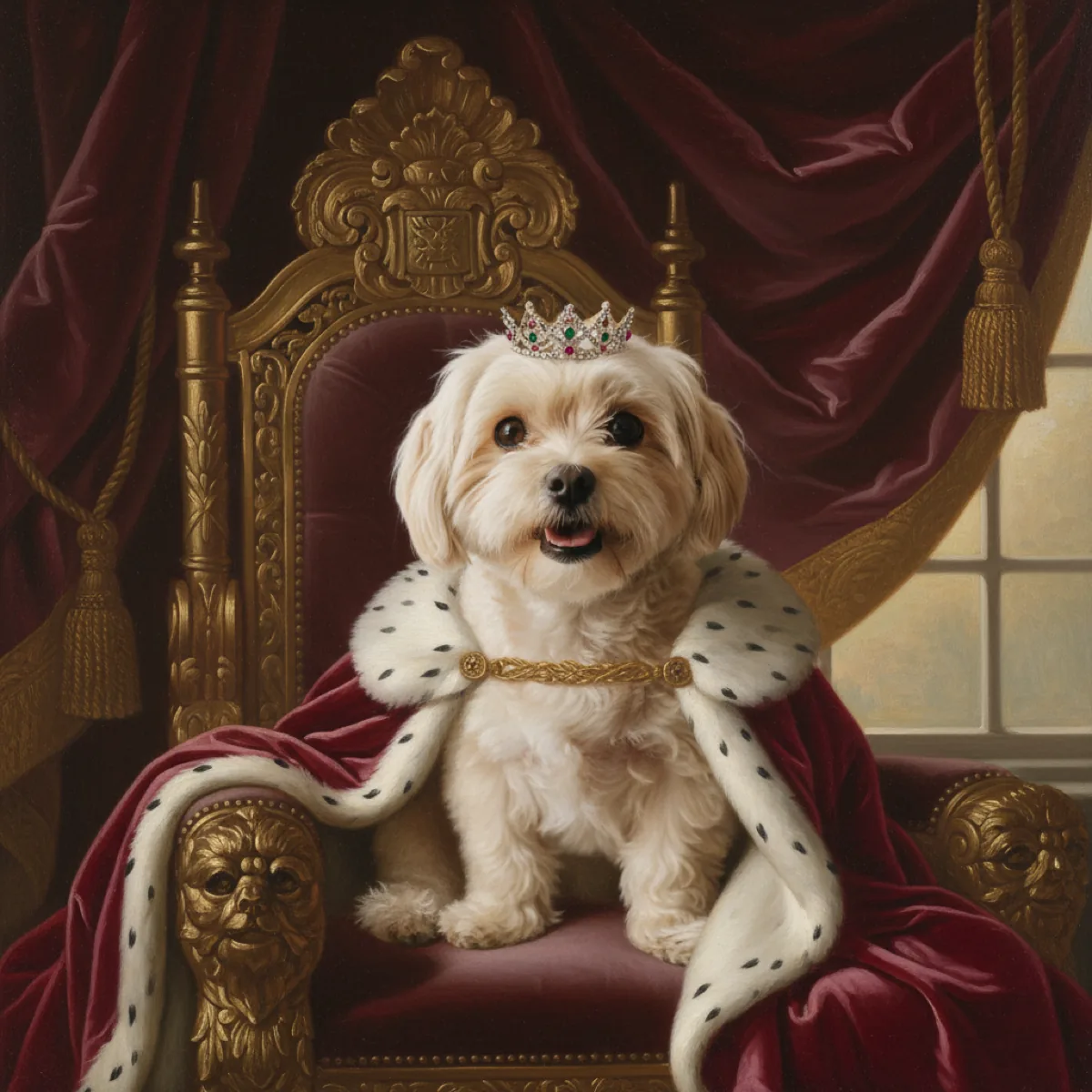
The phrase "royal dog breed" gets attached to roughly half the dogs in the AKC catalogue with very little discrimination. Most lists conflate "owned by a royal at some point" with "actually painted in royal portraiture across centuries." The two are different.
These are the twelve breeds with genuine, multi-century connections to royal portraiture - the breeds you can find in court paintings from 1500 onward, not just the breeds owned by a famous monarch in the last 200 years. For each, we pair the Olea and Hound style that suits the breed's actual bearing.
1. Pharaoh Hound
Ancient Egyptian court hound, painted on tomb walls 4,000 years ago. The breed was preserved on Malta as the Kelb tal-Fenek and remains the national dog of our home country.
The slim profile, the upright ears, the warm coat colour, the alert observant face - the Pharaoh Hound is arguably the most historically royal dog in dogdom. Egyptian court artists were painting them when most other breeds did not exist yet.
Style that suits: Royal Portrait or Oil Painting. The Pharaoh Hound's bearing carries the formal compositional rules effortlessly. The Royal Portrait works particularly well because the breed has actual royal-court provenance.
2. Saluki
The dog of Bedouin nobility for at least 3,000 years. Painted in Egyptian and later Persian court art. Each Saluki was traditionally given a name and kept in the household rather than the kennel - they were not considered dogs in the working sense but court companions.
Style that suits: Royal Portrait or Soft Watercolour. The long flowing coat of the feathered Saluki variety suits watercolour beautifully; the smooth variety suits Oil Painting and Royal Portrait better.
3. Borzoi
The Russian wolfhound, bred and refined at the imperial court at St Petersburg for centuries. Tsar Nicholas II personally maintained a Borzoi kennel; the breed was nearly extinct after the 1917 revolution and was rebuilt from a handful of court dogs.
The long elegant face, the deep narrow chest, the silky coat - the Borzoi was bred specifically to look noble. Every line of the dog was selected for aristocratic bearing.
Style that suits: Royal Portrait. No breed responds to the formal Royal Portrait composition better than the Borzoi.
4. Italian Greyhound
The Renaissance court dog. Painted by Pisanello, Veronese, and dozens of other Renaissance painters from the late 1400s onward. Italian Greyhounds were specifically painted because the breed embodied the renaissance ideal of refined, controlled beauty.
The Italian Greyhound is arguably the most painted breed in European portrait history.
Style that suits: Oil Painting or Royal Portrait. Both work; the Oil Painting draws directly on the Renaissance tradition the breed was painted in originally.
5. Cavalier King Charles Spaniel
Named for King Charles II of England, who was so attached to his spaniels that he allowed them to attend Parliament with him. The breed appears in dozens of court portraits from the late 1600s onward - on laps, at feet, peering from window seats.
The Cavalier is the soft, gentle counterpart to the more austere royal breeds. Court life, not court ceremony.
Style that suits: Soft Watercolour or Storybook. The long ears and silky coat suit watercolour exceptionally well. Royal Portrait is also viable but less natural to the breed's temperament.
6. Pekingese
The dog of the Forbidden City. Bred for the Chinese imperial court for over 2,000 years and forbidden from any non-imperial ownership for most of that period. The breed nearly went extinct after the 1860 sack of the Summer Palace; the surviving dogs were taken to England by British officers and refounded the modern breed.
Style that suits: Storybook or Soft Watercolour. The Pekingese's compact face and substantial coat resist the formal Royal Portrait composition - Storybook reads better. Soft Watercolour also works for the long-coat variety.
7. Great Dane (Deutsche Dogge)
Painted by Velazquez in his portrait of the Spanish royal court. The German Doggen line was specifically bred for the courts of the Holy Roman Empire as boar hounds, then refined as companion dogs for the imperial households.
The mass of the head, the calm temperament, the substantial frame - the Great Dane is unmistakably royal in bearing.
Style that suits: Oil Painting or Royal Portrait. Both work well. The Oil Painting style catches the breed's quiet dignity particularly cleanly.
8. English Mastiff
A breed mentioned in English royal records as far back as Henry VIII. The Mastiff has been painted as a court guardian dog for at least 500 years, often appearing in the foreground of royal hunting scenes or as a companion at the feet of kings.
Style that suits: Oil Painting or Royal Portrait. The Mastiff's bulk and head structure suit the formal compositions well. Soft Watercolour does not work - the breed needs the harder edges of oil painting to read correctly.
9. Bichon Frise
The lap dog of the French court at Versailles. Marie Antoinette is the most-cited owner, though the breed had been a court favourite for at least a century before her reign. The Bichon was painted into court scenes specifically as a marker of feminine refinement.
Style that suits: Soft Watercolour or Storybook. The Bichon's coat structure is built for watercolour rendering. Royal Portrait does not work as well - the breed's compact face and soft coat fight the formal composition.
10. Maltese
The companion dog of European royalty for over 2,000 years - mentioned in Greek and Roman writings, painted in Renaissance courts, beloved by Mary Queen of Scots and Queen Victoria. The Maltese was the canonical small lap dog for noble women across centuries.
The breed shares its name with our home country, and the historical association of Malta with elegant small dogs runs deep. Roman writers refer to the canis melitae as a luxury item more valuable than gold.
Style that suits: Soft Watercolour. The long silky coat is built for the medium. Storybook also works for younger or more playful Maltese.
11. Lhasa Apso
The temple dog of the Tibetan court. The Lhasa Apso was kept in monasteries and the homes of the Tibetan nobility as a watch dog and companion. The breed was considered to carry the souls of departed monks; Lhasa Apsos were never sold but only given as gifts by the Dalai Lama to honoured guests.
Style that suits: Soft Watercolour or Storybook. The long flowing coat suits watercolour. Royal Portrait can work for the more imperious examples of the breed.
12. Greyhound (English/Show Greyhound)
The hunting hound of English nobility from the Middle Ages onward. The Greyhound is the only breed mentioned by name in the Magna Carta (one of the early English legal limitations on what could be done to Greyhounds because the breed was specifically royal property). Painted constantly in medieval and Renaissance court hunting scenes.
Style that suits: Royal Portrait or Oil Painting. The clean profile and elegant frame of the Greyhound suit the formal compositions exceptionally well.
Honourable mentions that did not make the twelve
Briefly, four breeds we considered but excluded:
- Pug - genuinely royal-connected (House of Orange, then through to Marie Antoinette and Empress Josephine) but the breed's flat face fights formal portrait composition. Works in Storybook beautifully; struggles in Royal Portrait.
- Pomeranian - Queen Victoria's beloved breed; nearly an honourable mention. The reason we excluded: the modern Pomeranian is dramatically reduced from the medium-sized Spitz-type dog Victoria actually owned. The historical breed and the modern breed are visually different animals.
- Schipperke - the Belgian royal household's preferred small black dog; less internationally known. A good niche option for owners who want a genuinely royal breed that has not been over-claimed.
- Welsh Corgi - associated with Queen Elizabeth II for 70+ years. Strong contemporary royal connection but no multi-century portraiture provenance.
How to commission a royal-breed portrait
The procedure is the same as any Olea and Hound order:
- Photograph the dog in window light, three-quarter body framed, looking just past the camera (not directly into the lens). Our photo specification guide covers this in detail.
- Upload at oleaandhound.com.
- Choose the style we have recommended for the breed, or order the three-style tier to compare.
- Print at A2 on Hahnemühle paper.
- Frame in dark walnut or natural oak with a cream double mount.
- Hang above eye-line on a feature wall.
Total cost: €100-€135 for a framed A2 royal-breed portrait.
Frequently asked questions
Do you have a different style for each breed, or are all dogs rendered in the same way?
Each Olea and Hound style applies a specific compositional and aesthetic discipline regardless of breed. The breed and the photograph together influence how the rendering ends up looking, but the same Royal Portrait style applied to a Pharaoh Hound and a Pekingese produces two distinctly different portraits because the source material is different.
What about cross-breeds and rescues?
The same logic applies. If your rescue has the bearing of a Pharaoh Hound (slim, alert, observant), the Royal Portrait will suit them. If they have the bearing of a Bichon (soft, gentle, charming), Soft Watercolour will suit them. The breed name is shorthand for visual character; what matters is the actual character.
Is the Royal Portrait the most popular style across all breeds, or only royal-breed dogs?
It is in the top three across all breeds, but the share is higher for royal-bred dogs. Pharaoh Hounds, Borzois, Greyhounds, and Salukis order the Royal Portrait at roughly twice the rate of the general dog-portrait order book.
Can I commission a Royal Portrait of a working-class breed (a Border Collie, a Springer Spaniel)?
Yes. The portrait will be rendered. Whether the result reads as natural or slightly artificial depends on the specific dog's character. Order the three-style tier and compare Royal Portrait against Oil Painting before committing.
Do cats have royal breeds in the same way dogs do?
Yes - the Siamese (Siamese royal court), the Persian (Persian and Ottoman courts), the Chartreux (French monastic courts), the Maine Coon (American gentleman-farmer "court" by extension). The same style logic applies to cats. See our cat portrait line.
What if my dog is mostly one of these breeds but with mixed ancestry?
Half the dogs we render are mixed-breed or rescue dogs. Pick the style that suits the dog's bearing rather than their pedigree. A rescue with 60% Borzoi and 40% something-else will still likely suit the Royal Portrait if they have the Borzoi profile.
Begin with their photograph
Upload one photograph and see all six styles in 30 seconds. The Royal Portrait style is one of them. Free preview, refund within five minutes if it isn't them.
The twelve breeds are the deeply royal ones. The rest of the dog world is welcome to the style too - the bearing matters more than the bloodline.