What Makes a Pet Portrait Worth Keeping (And What to Avoid)
An honest guide to evaluating pet portrait services - what separates a portrait that earns a wall from one that ends up forgotten in an inbox folder.
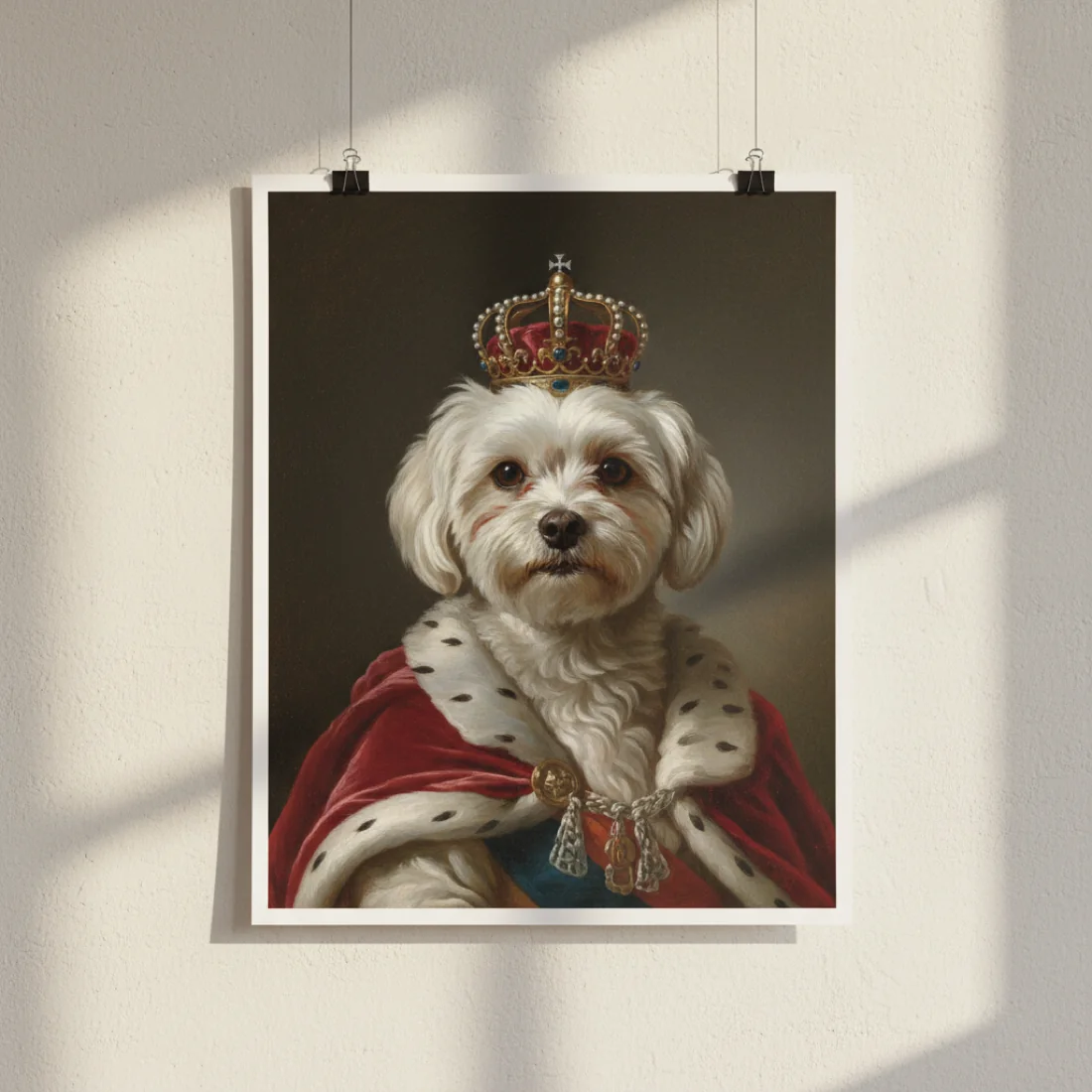
The pet portrait category has a problem. Most of what you can buy is technically a pet portrait, but very little of it earns a wall.
Half of what people order from the major sellers ends up in an inbox folder, never printed, never framed, occasionally remembered. That's not a critique of the buyers - they paid the right amount of attention at the moment of purchase. It's a critique of the category, which has not held itself to a high enough standard.
This is the honest test. If you're commissioning a portrait of your dog or cat in 2026, here's what to look for - and what to walk away from.
The seven tests of a portrait worth keeping
1. The likeness test - four seconds, not forty
The moment of truth on any custom pet portrait is the first four seconds the owner sees it. Either they recognise their dog instantly, or they don't.
If they're still studying the file forty seconds in, trying to convince themselves it looks like Hugo, the portrait has already failed. Genuine likeness is involuntary - it lands before you've finished blinking.
The test: show the rendered file to someone who's never met the dog, then to someone who has. The second person should react more strongly within two seconds.
2. The print test - 4,096 pixels minimum
This is the single technical specification that matters. A portrait file under 4,000 pixels on its longest edge looks soft once printed above A4.
The test: ask the service explicitly: "what's the file resolution?" If they answer in any unit other than pixels, or if the number is under 4,000, the portrait is print-limited - it'll work for phones and social, not for walls.
Our files are 4,096 × 4,096, print-ready to A2 with headroom for A1.
3. The frame test - would a real framer take it seriously?
Walk into a competent framer. Hand over the print. Watch their face.
If they comment positively on the composition or the contrast - it's worth framing. If they handle it the same way they'd handle any photo print, you're in the middle of the bell curve. If they hesitate, the underlying composition is weak.
The test: before you frame the print, look at it from across the room. A portrait that earns a wall holds your attention from two metres; one that doesn't, doesn't.
4. The signature test - would it sit comfortably next to a real painting?
Hang the framed print on the same wall as any genuine piece of art you already own. Step back. Look at both together.
The pet portrait should belong on that wall - not louder than the surrounding art, not quieter, not in a different visual language. If it looks like a printed graphic next to genuine work, the rendering style is off-brand for "fine-art portrait".
The test: does the portrait read as the same category of object as the other things you have framed at home? If yes, keep. If no, that's the answer.
5. The composition test - three-quarter turn, asymmetric weight
A passport-style head-on shot of a dog isn't a portrait, it's a pet ID photo. The classical conventions of portraiture - the ones used by Joshua Reynolds, Thomas Gainsborough, John Singer Sargent - involve a three-quarter turn, asymmetric weight, eye contact with the viewer.
The best pet portraits inherit these conventions. The worst ones reduce the dog to a mug-shot subject.
The test: is the dog facing slightly off-axis, with their weight visibly on one side, and meeting the viewer's eye? If yes, the portrait is following the right rules.
6. The cost-per-decade test
The framework most people use - "is €99 worth it for six styles?" - is the wrong framework. The right one is the cost-per-decade.
A portrait that earns a wall for ten years is worth roughly €0.85 a month. A portrait that ends up in an inbox folder is worth €99 of regret.
The test: before you order, look at the rendered preview on the screen. If you can imagine it on a wall in your home five years from now, it's worth keeping. If you can't, it isn't.
We let you see all six styles free, before any money changes hands - the entire point is that you make this decision on the rendered file, not on a stock thumbnail.
7. The "what would you say to a friend" test
If a friend showed you the rendered portrait and asked whether they should print and frame it - what would you say?
If your honest answer is "yes, absolutely, this is them", you have a portrait worth keeping. If your honest answer is "it's nice, you could", you don't.
The portrait that earns a wall passes this test without effort. The one that doesn't fails it the moment you're forced to say something aloud.
What to walk away from
A short list of red flags. Any one of these, in 2026, is enough to choose a different service:
- "Hand-painted by artists" with 3-day delivery - mathematically impossible. It's AI rendering with a marketing layer.
- No preview before payment - the seller is hoping you won't notice the likeness gap.
- All sales final on a custom-from-photo product - the seller knows the likeness rate isn't 100% and won't refund.
- Watermark on the final file - some sellers deliver the file with a permanent watermark, requiring an upsell for the clean version. Watch for it in the Terms.
- File below 3,000 pixels - it's a social-media graphic, not a print.
- Costume rendering as the default - if the only style they offer is "renaissance" or "popart" or "astronaut", they're a novelty shop, not a portrait studio.
- No information about the rendering method - if they can't or won't tell you how the portrait is made, that's the answer.
What to look for instead
Six small signals that a service takes the craft seriously:
- Specific style language - "soft chiaroscuro", "court-painter framing", "three-quarter turn" rather than "renaissance vibes".
- Composition rules visible across their portfolio - the same compositional principles applied across multiple dogs, not random.
- A free preview - the service trusts the result enough to show you before charging.
- A short, named style list - six considered styles is a stronger signal than sixty novelty options.
- Honesty about AI - in 2026, the studios doing this well say so plainly. The ones still pretending are the ones to avoid.
- A clear refund window - five minutes is enough; thirty days is suspicious (it implies low conversion confidence and high return rate).
What we built
Olea & Hound is the answer we wanted to exist for our own dogs.
Six fine-art styles, considered. Free preview before payment. Five-minute refund if it isn't them. Files at 4,096 × 4,096 - print-ready up to A2. A numbered Certificate of Authenticity in your pet's name, signed by the atelier. Composed in a European atelier on the edge of an olive grove in Mdina, Malta.
From €39 for one style, €69 for three, €99 for all six. No shipping, no waiting, no warehouse-in-Asia.
The portrait you choose has to pass the seven tests above. If we don't, we'll refund. That's the deal.
Begin with their photograph
Upload one phone photo of your dog or cat. Thirty seconds later, six considered fine-art portraits, free preview, certificate signed in their name.
The seven tests are the bar. Hold us to them.